

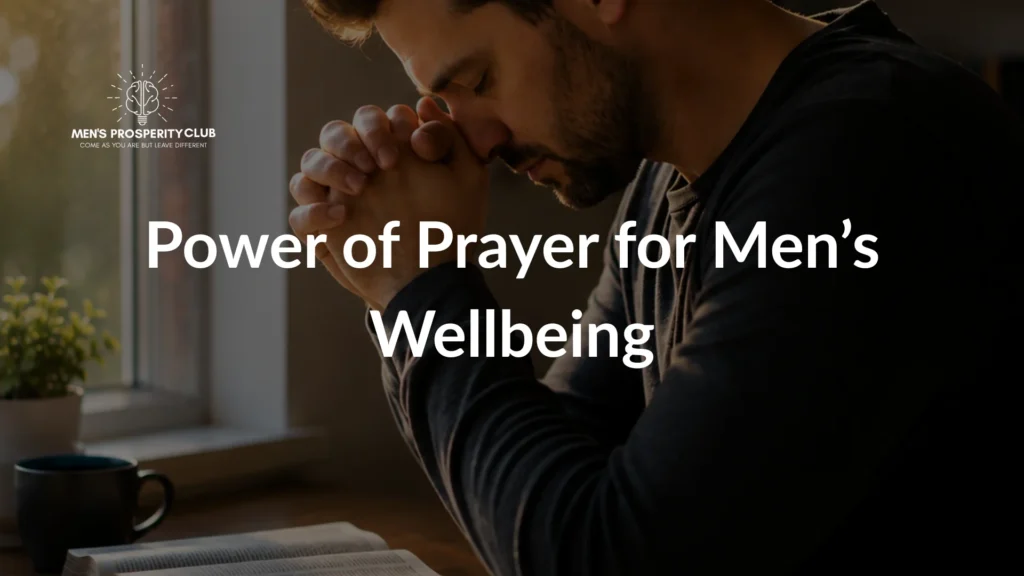
For centuries, men have turned to prayer as a source of strength, clarity, and comfort during life’s most difficult moments. The power of prayer lies not only in its spiritual dimensions but in its measurable effect on mental wellbeing, emotional resilience, and a sense of purpose.
Key Takeaways
- Prayer has been linked to reduced anxiety, lower stress levels, and improved emotional regulation in multiple UK-based studies.
- Men who practise prayer regularly report stronger feelings of community, belonging, and personal purpose.
- Faith does not need to be tied to a specific religion for prayer to offer psychological benefit.
- Birmingham men’s communities, including Men’s Prosperity Club, are actively integrating faith and values into mental health conversations.
- Prayer works best as part of a broader approach to wellbeing that includes peer support, physical activity, and honest conversation.
- Combining prayer with community connection creates a particularly powerful foundation for long-term resilience.
Why Men Struggle to Talk About Faith and Wellbeing
There is a well-documented reluctance among men in the United Kingdom to discuss emotional struggles. According to the Mental Health Foundation, men are significantly less likely than women to seek help for mental health difficulties, and suicide remains the leading cause of death for men under 50 in the UK. Within that context, faith and prayer often go unacknowledged as legitimate tools for coping, yet many men quietly rely on them every single day.
The cultural pressure on men to “get on with it” creates a double layer of silence. Not only do men avoid discussing low mood or anxiety, they also avoid discussing the spiritual practices that help them manage those feelings. Prayer becomes something practised privately, in isolation, rather than shared openly as part of a broader conversation about health and identity.
This is a missed opportunity. Research from the University of Oxford’s Centre for the Study of Social Cohesion has explored how religious and spiritual practice supports community cohesion, and the NHS has acknowledged spiritual care as a legitimate part of holistic wellbeing, particularly in palliative and mental health settings. What men need is a space where faith is treated with the same respect as fitness, finance, or any other element of a healthy life.
What the Research Actually Says About the Power of Prayer
The power of prayer has been the subject of growing academic attention in the UK and globally. Studies consistently show that regular prayer is associated with:
- Lower levels of cortisol, the body’s primary stress hormone
- Reduced symptoms of depression and anxiety
- Greater sense of meaning and life satisfaction
- Improved self-regulation and impulse control
- Enhanced feelings of social connectedness
A study published in the British Journal of Psychiatry found that religious coping strategies, including prayer, were associated with better mental health outcomes in a range of patient groups. Separately, the NHS has highlighted mindfulness-based practices, several of which share structural similarities with meditative forms of prayer, as effective tools for managing stress and anxiety.
It is important to be clear that prayer is not a medical treatment. It does not replace therapy, medication, or professional mental health support. But as a complementary practice, particularly when combined with community connection and physical wellbeing, it offers something genuinely valuable: a moment of stillness, an act of surrender, and a reminder that one is not entirely alone in facing life’s weight.
| Practice | Mental Health Benefit | Spiritual Benefit | Social Benefit |
|---|---|---|---|
| Daily prayer | Reduces anxiety and stress | Strengthens sense of purpose | Connects to faith community |
| Meditation | Improves focus and calm | Encourages self-reflection | Often practised in groups |
| Walk-and-talk sessions | Reduces isolation | Encourages reflection outdoors | Builds peer connection |
| Journalling | Processes emotions | Clarifies values | Can be shared in groups |
| Community worship | Lowers depression risk | Deepens faith | Strong belonging effect |
Faith, Brotherhood, and the Men’s Prosperity Club
Men’s Prosperity Club, based in Birmingham, is one of a growing number of community organisations in the UK recognising that faith is not separate from mental health. It is, for many men, central to it. The club provides a safe, judgement-free space where men can talk openly about all aspects of their lives, including their spiritual lives, without fear of being dismissed or ridiculed.
Faith sits alongside fitness, finance, and relationships as a core theme within the Men’s Prosperity Club community. This reflects a genuine understanding that men are whole human beings, not just a collection of problems to be solved. Whether a man prays five times a day, attends Sunday services, or simply finds quiet meaning in personal reflection, his experience is valid and welcomed.
The organisation’s walk-and-talk sessions create a particularly natural environment for these conversations. Walking alongside someone, rather than sitting face-to-face in a formal setting, lowers psychological defences and opens up more honest dialogue. Many men find it easier to speak about faith, doubt, or spiritual struggle when they are in motion, breathing fresh air, and not under the pressure of a clinical or formal environment.
For men who want to explore more of what MPC covers across topics like mental health, relationships, and personal growth, the blog is a strong starting point, covering practical insights written specifically for men navigating real life challenges.

Practical Ways Men Can Incorporate Prayer Into Daily Life
Prayer does not need to follow a rigid formula. For men who are new to the practice, or returning to it after years away, the approach matters less than the intention behind it. Here are practical entry points:
- Morning grounding prayer: Spend two to three minutes before starting the day expressing gratitude and setting an intention. This anchors the day in something larger than work or routine.
- Reflective evening prayer: Before sleep, mentally review the day without judgement. Offer up what went wrong, acknowledge what went well, and release tension consciously.
- Communal prayer: Join a faith group, mosque, church, synagogue, gurdwara, or spiritual community. The shared experience deepens the sense of belonging.
- Prayer walks: Combine physical movement with contemplation. This overlaps naturally with the walk-and-talk model that groups like Men’s Prosperity Club use.
- Written prayer: Some men find it easier to write prayers in a journal. This bridges the gap between prayer and reflection, creating a record of personal growth over time.
The connection between physical health and emotional wellbeing is well established, and the same interconnected logic applies to faith. Readers interested in how physical activity supports mental clarity might also find value in reading about brain exercises for better focus and memory in men, which complements the kind of cognitive clarity that regular prayer also encourages.
Similarly, for men interested in how wellbeing extends across all areas of life, including intimate relationships, exploring the sexual link between health and mental well being offers a useful perspective on how interconnected health truly is.

The Cultural Context: Faith, Masculinity, and Community in the UK
The United Kingdom is home to a rich diversity of faith traditions. According to the Office for National Statistics, the 2021 Census showed that 46 per cent of people in England and Wales identified as Christian, while significant proportions identified as Muslim, Hindu, Sikh, Jewish, or of other faiths. Birmingham, in particular, is one of the most religiously diverse cities in the country.
For men within these communities, prayer is not a new concept. It is woven into the fabric of daily life, family structure, and cultural identity. The challenge is not introducing men to prayer; it is creating space for men to speak openly about what their faith means to them and how it supports or sometimes complicates their mental health.
Men’s Prosperity Club acknowledges this by treating faith as one of several pillars of a man’s life, not a separate or optional extra. This approach sits naturally alongside campaigns and awareness days that aim to bring men’s health into open conversation. For anyone who wants to understand how awareness events create genuine change, mens mental health day raising awareness and support in birmingham uk explains how community-led initiatives are making a real difference in the city.
The same spirit drives movements like Movember, which has raised millions of pounds for men’s health research and support in the UK. Understanding why movember matters understanding its impact on mens health puts into context how public conversation around men’s wellbeing has evolved significantly in recent years.
Financial stress is another area where men often suffer in silence, and it is closely linked to mental health outcomes. For men trying to manage financial pressure alongside their faith and emotional wellbeing, financial fitness money management tips for men in 2025 offers grounded, practical guidance.
Things to Know
- Prayer and meditation share neurological similarities. Both activate the prefrontal cortex, which is associated with emotional regulation and decision-making.
- Men from Black, Asian, and minority ethnic backgrounds in the UK are statistically more likely to hold religious beliefs and engage in regular prayer, making it especially relevant in diverse cities like Birmingham.
- Doubt is a normal part of a faith journey. Men do not need to have certainty to benefit from prayer; the act of reaching outward is itself meaningful.
- Prayer is not exclusively religious. Many secular men use contemplative practices, including gratitude reflection and silent meditation, that function similarly to prayer in their effect on wellbeing.
- Community prayer, whether in a mosque, church, or informal group, has a stronger positive effect on mental health than solitary prayer in most studies, due to the social dimension.
- Men who combine physical activity with spiritual practice, such as prayer walks, tend to report higher levels of sustained emotional resilience than those who do either alone.
Join Men’s Prosperity Club and Build Your Foundations
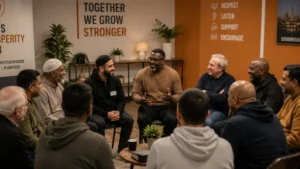
Men’s Prosperity Club in Birmingham is open to all men who want to grow, connect, and build a stronger life from the inside out. Whether faith is already central to a man’s identity or something he is only beginning to explore, there is a place here where those conversations are welcomed without judgement. The community brings together men at all stages of life, offering peer support, walk-and-talk sessions, and honest discussions about everything from mental health to finances to purpose.
If a man is ready to be part of a genuine brotherhood where every voice matters and no topic is off limits, reaching out to Men’s Prosperity Club is the next step worth taking.
Frequently Asked Questions
Q: Does prayer actually help with anxiety and depression?
Research suggests that regular prayer can reduce symptoms of anxiety and depression, particularly when combined with community connection and other wellbeing practices.
A study published in the British Journal of Psychiatry found that religious coping strategies, including prayer, were associated with improved mental health outcomes. Prayer is not a replacement for professional support but can be a meaningful complement to therapy, medication, or peer support.
Q: Do I need to be religious to benefit from prayer?
No. Many men who do not identify with a specific religion practise forms of contemplative reflection or gratitude that function in a similar way to traditional prayer.
What matters most is the intention of pausing, reflecting, and connecting with something beyond everyday pressures. Whether framed as prayer, mindfulness, or quiet reflection, the psychological benefits overlap considerably.
Q: How can I start praying if I have no experience?
Starting with two to three minutes of quiet reflection in the morning, focusing on gratitude and intention, is one of the most accessible entry points.
There is no correct format. Many men begin simply by speaking honestly about their fears, hopes, and gratitude, either silently or aloud. Over time, a personal rhythm develops naturally.
Q: Can faith be part of men’s mental health support in a secular group?
Yes. Groups like Men’s Prosperity Club in Birmingham treat faith as one of several legitimate dimensions of a man’s life and welcome open conversations about it alongside mental health, relationships, and personal growth.
Faith does not need to be the focus of every conversation, but it should never be dismissed as irrelevant. For many men, it is the foundation from which everything else is built.
Q: Is there a link between community worship and better mental health outcomes?
Yes. Multiple studies have found that communal religious practice is associated with lower rates of depression, greater social support, and stronger feelings of meaning and purpose.
The social element of shared worship appears to be a significant factor. The combination of shared ritual, belonging, and regular connection with a trusted community offers a powerful buffer against isolation and low mood.
The Bottom Line on the Power of Prayer
The power of prayer is real, nuanced, and relevant to men’s mental health in ways that are only beginning to receive the open discussion they deserve. It is not a cure-all, and it is not the only tool available, but for many men it represents a consistent, grounding practice that supports resilience, reduces anxiety, and strengthens the sense that life has meaning and direction.
For men in Birmingham and beyond, resources like Men’s Prosperity Club offer a rare combination: a community that takes both mental health and faith seriously, without pushing either to the margins. The next step is simple. Reach out, show up, and start the conversation.