
Emotional healing is the process of acknowledging, processing and recovering from painful experiences, trauma or suppressed feelings that affect everyday life. For men in particular, this journey often begins with the simple but powerful decision to stop carrying things alone.
Key Takeaways
- Emotional healing is not a single event but an ongoing process that builds resilience over time.
- Men are less likely to seek support due to cultural expectations, but this is changing across the UK.
- Community connection, peer support and honest conversations are among the most effective tools for healing.
- Physical activity, financial wellbeing and cognitive habits all contribute to emotional recovery.
- You do not need a diagnosis or crisis point to begin working on your emotional health.
- Groups like Men’s Prosperity Club in Birmingham offer free, judgement-free support for men at any stage of their journey.
Why Men Struggle to Begin the Process
There is a well-documented pattern in the UK where men delay seeking help for emotional difficulties far longer than women. According to NHS data on men’s mental health, men are significantly less likely to access psychological therapies, and male suicide rates in England remain three times higher than those of women. These are not signs of emotional weakness. They are the result of decades of cultural messaging that told men their feelings were either irrelevant or a liability.
The idea that men should simply “get on with it” has done enormous damage. It has created a generation of men who are emotionally skilled at surviving but not at healing. The difference matters. Survival mode keeps a man functioning. Healing allows him to actually thrive.
This cultural shift is something Men’s Prosperity Club, based in Birmingham, is actively working to support. The organisation believes that vulnerability is a strength, not a flaw, and provides a community space where men can begin to unpack the emotional weight they have been carrying. Understanding why movember matters understanding its impact on mens health gives important context to just how urgent this conversation has become across the country.
What Emotional Healing Actually Involves
The term gets used loosely, but emotional healing is a structured, often non-linear process with identifiable stages. It is not simply feeling better after a bad week. It involves moving through several layers of experience.
Acknowledgement
The first stage is recognising that something has affected you. This sounds obvious, but for many men, years of suppressing emotion means they have genuinely lost touch with what they are feeling. A helpful first step is simply naming it: grief, anger, shame, loneliness, disappointment.
Processing
Once feelings are acknowledged, they need somewhere to go. This might involve talking with trusted people, journaling, therapy, physical movement or creative outlets. Processing is not about endlessly dwelling. It is about moving through rather than around.
Integration
This is where healing becomes real. Integration means making sense of an experience, learning from it and carrying it forward without being controlled by it. A man who has integrated a painful experience is not someone who has forgotten it. He is someone who has made peace with it.
Rebuilding
The final stage involves actively constructing the life and identity that comes after pain. This includes rebuilding confidence, relationships and purpose. The Men’s Prosperity Club blog regularly covers themes around this kind of personal rebuilding, offering practical insights tailored specifically to men.
The Connection Between Physical and Emotional Health
One of the most underappreciated aspects of emotional healing is how closely it is tied to physical wellbeing. The mind and body are not separate systems. When a man is emotionally exhausted, he often notices it physically too: poor sleep, tense muscles, low energy, reduced concentration.
Research from the Mental Health Foundation UK consistently shows that regular physical activity has a significant positive impact on anxiety and depression. Exercise does not just burn calories. It regulates cortisol, boosts serotonin and gives the nervous system a way to discharge stress.
Similarly, exploring the sexual link between health and mental well being reveals how closely emotional states affect physical intimacy and vice versa. When a man is struggling emotionally, it often shows up in his relationships, his libido and his sense of self. Addressing one feeds into the other.
Cognitive health also plays a role. Working on brain exercises for better focus and memory in men is not just about productivity. When the mind is sharper and more focused, men are better placed to process emotions, regulate responses and engage meaningfully with others.

Common Barriers to Emotional Healing in Men
Understanding what gets in the way is just as important as knowing the path forward.
| Barrier | How It Shows Up | What Helps |
|---|---|---|
| Stigma | Avoiding conversations about feelings | Peer communities, normalisation through awareness campaigns |
| Isolation | Withdrawing from friends and family | Structured social groups, walk-and-talk sessions |
| Financial stress | Anxiety that blocks emotional processing | Financial literacy, budgeting support, reducing uncertainty |
| Lack of role models | No examples of men talking openly | Community spaces that model healthy emotional expression |
| Distraction and avoidance | Overworking, excessive screen time, alcohol | Structured routines, accountability partnerships |
| Fear of being judged | Silence even in close relationships | Judgement-free environments like Men’s Prosperity Club |
Financial stress deserves specific mention here. It is one of the most common but least discussed triggers for emotional difficulties in men. Debt, job insecurity and money worries compound emotional pain significantly. Reading about financial fitness money management tips for men in 2025 can be a useful starting point for men who notice that financial anxiety is tangled up with how they feel emotionally.
The Role of Community in Recovery
There is a growing body of evidence that social connection is one of the most powerful protective factors for mental health. Mind, the mental health charity, highlights that isolation is a significant risk factor for depression and that peer support can be as effective as professional therapy for many people.
Men’s Prosperity Club offers several formats for community-based support, including peer support sessions, walk-and-talk wellbeing events and community discussions. These are not clinical settings. They are spaces where men from all backgrounds can show up, be heard and leave feeling less alone.
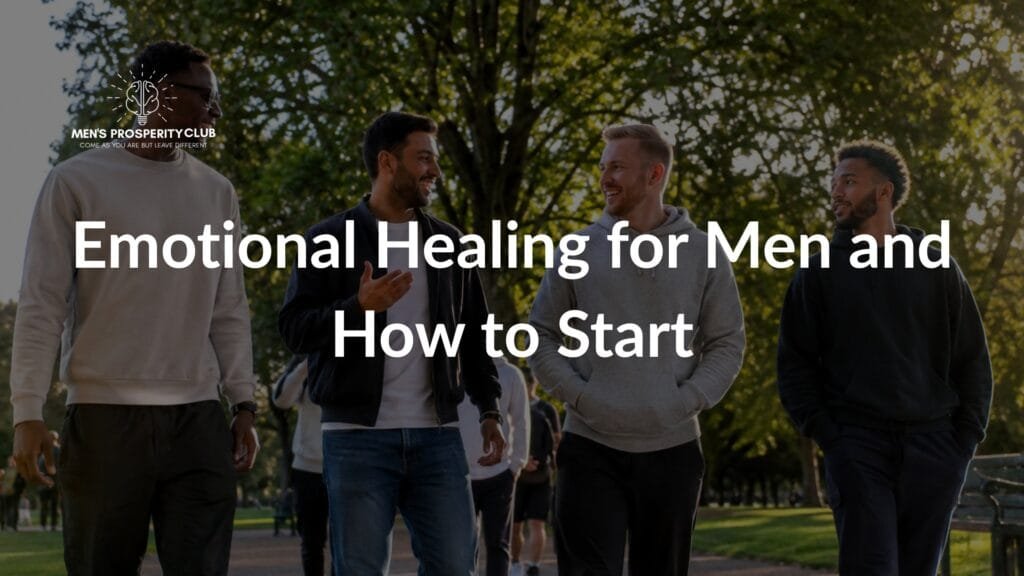
The walk-and-talk model is particularly effective. Movement reduces anxiety, the outdoor setting feels less pressured than a room with chairs, and walking side-by-side rather than face-to-face naturally encourages men to open up. It is a simple idea, but the impact is real.
Events like mens mental health day raising awareness and support in birmingham uk show that the demand for these spaces exists. Men are looking for permission and opportunity to talk. They just need the right environment.
Practical Steps to Begin Emotional Healing
Starting does not require a therapist, a diagnosis or a crisis. It requires small, consistent actions taken with honesty and intention.
- Name what you are feeling. Do not skip this step. Giving a name to an emotion reduces its intensity. Research from the British Psychological Society supports the idea that emotional labelling activates the prefrontal cortex and reduces amygdala activity, effectively calming the brain’s stress response.
- Talk to someone you trust. This does not need to be a formal conversation. A walk with a friend, a message to a mate or attending a community session all count.
- Reduce the things that block healing. Excessive alcohol, poor sleep and avoidance behaviours all delay recovery. They are understandable coping mechanisms, but they need to be gently replaced.
- Create routine. Emotional healing happens in conditions of stability. Regular sleep, exercise and meals give the nervous system a platform to recover.
- Seek professional support when needed. If feelings are persistent, overwhelming or affecting your ability to function, speaking to a GP is the right step. The NHS talking therapies service offers free, evidence-based support across England.
- Be patient. Healing is not linear. Progress looks like getting back up, not never falling.
Things to Know
- Emotional healing often feels worse before it feels better. Processing suppressed emotions can be uncomfortable, and that discomfort is usually a sign that the work is happening.
- You do not need a single identifiable trauma to benefit from working on your emotional health. Chronic stress, low-grade dissatisfaction and years of emotional suppression are all valid starting points.
- Asking for help is not weakness. In fact, it takes considerably more courage to face your inner world than to avoid it.
- Men’s Prosperity Club is free to join and open to men from all backgrounds in Birmingham, no referral or diagnosis required.
- Healing is not about becoming a different person. It is about becoming a more honest and resilient version of who you already are.
- Maintaining momentum matters. Regular attendance at support groups, consistent physical activity and ongoing self-reflection all sustain progress far better than occasional bursts of effort.

Join Men’s Prosperity Club and Take the First Step
Men’s Prosperity Club in Birmingham is a free, community-led support group built for men who are ready to stop carrying things alone. Whether someone is in the middle of a difficult period or simply wants to connect with other men who understand, there is a place here for them. The community runs regular walk-and-talk sessions, peer support meetings and events designed to help men build resilience, connection and genuine prosperity in every area of life. Reach out, attend a session and find out what a supportive brotherhood can do for your wellbeing.
Frequently Asked Questions
Q: How long does emotional healing take?
There is no fixed timeline, and healing looks different for every man.
Some people notice meaningful shifts within weeks of starting to open up and take consistent action. For others, particularly those dealing with deep grief, trauma or long-term suppression, the process can take months or years. The important thing is not the speed but the direction.
Q: Can men heal emotionally without professional therapy?
Yes, many men make significant progress through peer support, community connection, lifestyle changes and self-reflection.
That said, professional therapy is a valuable resource and is not something to avoid out of pride. For persistent or severe difficulties, speaking to a GP or accessing NHS talking therapies is strongly recommended.
Q: What is the difference between healing and just feeling better temporarily?
Feeling better temporarily often means the pain has been numbed or avoided, whereas healing means it has been genuinely processed and integrated.
A helpful indicator is whether difficult emotions from the past still control present behaviour. If old wounds are still running the show, the healing work is ongoing.
Q: Is emotional healing relevant for men who have not experienced obvious trauma?
Absolutely. Many men carry emotional weight from years of suppression, unmet needs, loneliness or chronic stress, none of which require a dramatic event to be significant.
Healing is not only for people who have been through clearly defined tragedies. It is for anyone who wants to live with more clarity, connection and peace.
Q: How can joining a men’s support group help with emotional healing?
Peer support groups reduce isolation, normalise emotional conversations and provide accountability, all of which are key conditions for healing.
Sharing experiences with other men who understand, without fear of judgement, creates a safe environment where emotional processing becomes more accessible. Men’s Prosperity Club in Birmingham is built precisely around this principle.
The Bottom Line on Emotional Healing
Emotional healing is not about becoming someone who never struggles. It is about building the capacity to face difficulty honestly, process it with support and keep growing. For men in the UK, the cultural pressure to suppress and soldier on has caused real harm, but that story is changing. Communities, conversations and the courage to be honest are all part of the shift.
The best action a man can take today is a simple one: reach out. Whether that is talking to a friend, attending a Men’s Prosperity Club session in Birmingham or booking an appointment with a GP, the first step matters more than the perfect plan.