
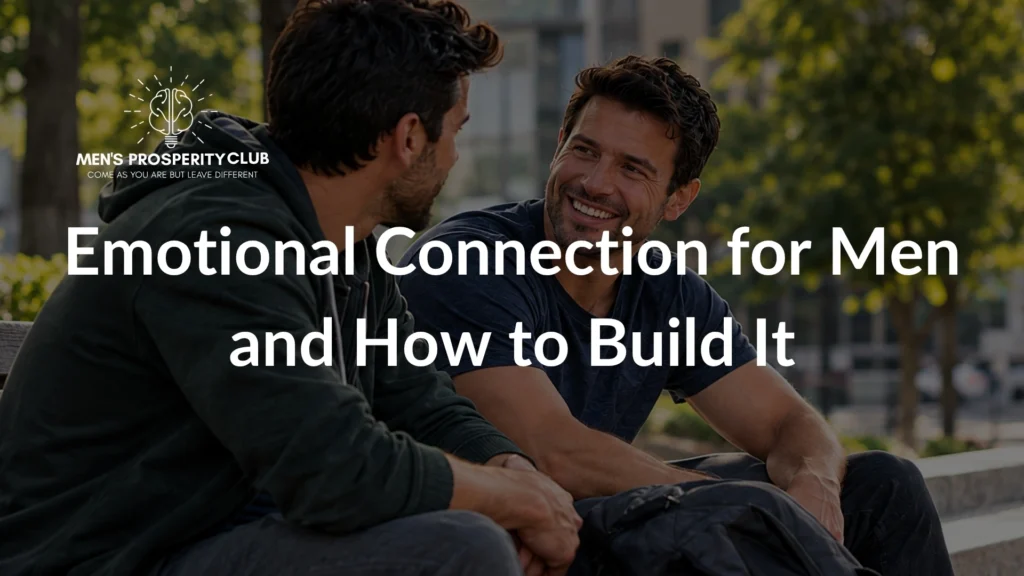
Emotional connection is the feeling of being understood and valued by someone who listens without judging. For many men it grows through small habits such as honest conversation and shared time. You can build it at any age with a partner or friends or family.
Many men are surrounded by people and still feel that nobody really knows how they are. That gap is what this guide is about. Emotional connection is not about talking for hours or sharing every feeling. It is about feeling safe enough to be yourself with another person.
This article explains what emotional connection looks like and why it can feel hard to find. It also offers practical steps for building it and explains when extra support makes sense. Everything here is written to be useful without any pressure.
This article is general information and not medical or mental health or legal or relationship advice. Men’s Prosperity Club is a peer support community and not a crisis or clinical service. If you are worried about your health then please speak to a GP.
What is emotional connection and why does it matter?
Emotional connection is the bond you feel with someone when you can be honest and expect to be heard. It is built on trust and attention and a willingness to show up. It can exist between partners and between friends and between a father and his children.
It matters because feeling understood helps you cope with life’s pressures. Strong bonds give you people to turn to when work or money or family life gets heavy. Without them it is easy to carry everything alone.
Connection is also different from simply being around people. Mind explains that loneliness is the feeling that arises when your need for social contact and relationships is not met. You can feel lonely in a crowd or content on your own. What counts is whether you feel understood.
What does emotional connection look like in everyday life?
It often looks more ordinary than people expect. It is rarely a grand conversation. It is usually a pattern of small moments that add up over time.
With a partner
You can talk about your day and also about your worries. Disagreements get resolved without either of you feeling dismissed. You can say what you need and hear what they need. Our article on the qualities of a healthy relationship sets out what this looks like in practice.
With friends
You can ask for advice or admit that you are struggling. You check in on each other between nights out. Time together is not only about the football or the pub. Even one friend who knows how you are really doing can make a difference.
With family
You can be honest with your children or parents or siblings about what matters to you. Many men show care through actions such as fixing things or providing. Those acts count. Adding a few words about how you feel can help others understand the love behind them.

Why can emotional connection feel hard for many men?
For many men the difficulty is not a lack of feeling. It is a lack of practice. Growing up you may have heard messages such as “keep it together” or “do not make a fuss”. Habits formed early can be hard to unlearn.
Keeping feelings to yourself
Holding things in can feel safer in the short term. Over time it can leave people close to you guessing how you feel. Our post on the importance of emotional expression in men explains why putting feelings into words is a strength and not a risk.
Pressure and busy lives
Long hours and money worries and family demands leave little energy for conversation. Stress can also make you short with people you care about. If this sounds familiar then read about managing relationship stress as a man.
Fear of being judged
Opening up can feel risky if you worry about being laughed at or dismissed. That worry is common and understandable. It is also why choosing the right person and the right moment matters so much.
Drifting into distance
Sometimes distance builds slowly without anyone deciding on it. If a partner or friend has described you as hard to reach then this guide to the signs of emotional unavailability and how to address them may help you spot patterns without blaming yourself.
What are the signs that emotional connection is missing?
No single sign proves that a bond is weak. Look for patterns that last for weeks and not for one bad day.
- You talk about plans and logistics but rarely about how you feel.
- You feel alone even when other people are in the room.
- Conversations with a partner often end in silence or an argument.
- You say “I’m fine” when you are not.
- You have stopped contacting friends you used to see regularly.
- You find it hard to say what you need.
Many people feel this way at times so there is no need for shame. The NHS reminds readers that loneliness affects almost everyone at some point and that nobody should feel embarrassed about it. The Mental Health Foundation also offers a guide to what loneliness is and ways to cope with it.
How can you build emotional connection step by step?
You do not need a big gesture. Small and repeated actions tend to work better than one dramatic conversation. This simple sequence can help you start.
- Start with listening. Put your phone away and give the other person your full attention. Ask a follow-up question before you offer advice.
- Name one feeling a day. Notice how you feel and say it aloud or write it down. A plain word such as “tired” or “worried” or “pleased” is enough.
- Create emotional safety. People open up when they expect to be heard and not criticised. This article on emotional safety explains what it means and how to create it.
- Build your emotional intelligence. Understanding your own reactions and noticing other people’s makes conversations easier. Read why emotional intelligence is important in relationships for practical ideas.
- Make regular time. Plan a walk or a meal or a call that happens on a schedule. Consistency builds trust.
- Try one bolder conversation. Share something real about your week. Our guide to eight ways to strengthen emotional connection in relationships has more ideas you can use.

Which approaches suit which relationship?
Different relationships call for different starting points. The table below gives a quick comparison.
| Relationship | A simple starting point | What it may build |
|---|---|---|
| Partner | A short check-in each evening without screens | Trust and a sense of being a team |
| Close friend | A walk and a proper catch-up once a fortnight | Honesty and shared support |
| Parent or sibling | A regular phone call with one real question | Understanding across generations |
| Your children | Time doing something they choose | Security and openness over time |
| Wider community | A men’s group or a local activity | Belonging and fresh perspective |
There is no perfect method so try one or two and keep what works. Real change comes from repetition and not from intensity.
How do boundaries and different ways of showing love affect connection?
Connection is not the same as constant closeness. Healthy bonds leave room for each person to have their own needs and limits. Our article on why men need healthy boundaries in relationships explains how limits can protect a relationship and not damage it.
People also express care in different ways. One partner may value words while another values time or practical help. Learning what the seven love languages are and how they work can help you recognise care that you may have missed and show it in a way the other person understands.
It is also worth noticing if connection has become one-sided. Relying on one person for all your emotional needs can put pressure on both of you. This guide to breaking free from emotional dependency in relationships helps you build balance.
What are the common mistakes and myths about emotional connection?
Myth: Strong men do not need emotional closeness. Every person needs to feel understood. Needing connection is part of being human.
Myth: Connection means talking about everything. It does not. Some bonds grow through shared activity and quiet company.
Myth: Opening up will make you a burden. Most people feel trusted when someone shares honestly with them. Many are relieved that someone else has said it first.
Mistake: Waiting until things are bad. Small conversations now are easier than a big one later.
Mistake: Expecting one person to meet every need. Friends and family and community each play a different part.
Mistake: Using advice as a way to avoid feelings. Offering a solution too quickly can leave the other person feeling unheard. Listening first often helps more.
How can peer support help you connect with other men?
Sometimes the easiest place to practise is a group where everyone is in a similar position. Men’s Prosperity Club offers free and judgement-free peer support in Birmingham through walk-and-talk sessions and community discussions. Walking side by side takes the pressure off eye contact and makes conversation feel more natural.
In a community discussion you can share your experiences and listen to others. You can hear different perspectives and feel heard. There is no hierarchy so every voice matters equally.
Other peer groups can also help. Andy’s Man Club runs free peer support groups for men across the UK and online. Its groups meet on Mondays at 7pm and you do not need to book. Peer support is not a clinical service. It works alongside professional help and does not replace it.

When should you get professional support and from whom?
Consider speaking to someone if a lack of connection is affecting your sleep or mood or everyday life. Seek help too if you are pulling away from people or feeling hopeless. Needing support is a sensible and practical step.
Your GP is a good first step. If you live in England you can refer yourself to NHS talking therapies for anxiety and depression without seeing a GP. You need to be registered with a GP and aged 18 or over in most areas. If the difficulty is mainly within a relationship then Relate offers relationship counselling and advice.
If you find it hard to start a conversation then Mind has a guide to opening up about your mental health. The NHS also offers tips on talking about your mental health with someone you trust.
Some life events can make connection harder. A relationship ending is one of them. Read more in our guide to men’s mental health after a breakup. For a wider view of building wellbeing over time see our guide to men’s emotional wellness.
If you need support now. Speak to a GP or call NHS 111 for urgent advice that is not an emergency. You can call Samaritans free on 116 123 at any time. The CALM helpline is open from 5pm to midnight. If your life is at immediate risk then call 999 or go to A&E.
Key Takeaways
- Emotional connection is the feeling of being understood and not just being around people.
- Many men find it hard because of habit and pressure and fear of judgement and not because of a lack of feeling.
- Small and regular actions such as listening and naming a feeling build trust over time.
- Emotional safety and healthy boundaries help bonds last.
- Friends and family and community each play a different part so no single person has to carry everything.
- Peer support can sit alongside professional help.
- Persistent loneliness or distress deserves a conversation with your GP.
Frequently Asked Questions
What is emotional connection in a relationship?
It is the sense of being understood and valued by your partner. It grows through listening and honesty and time together. It is built over weeks and months and not in a single conversation.
Why do some men find emotional connection difficult?
Many men learn early to keep feelings private. That habit can make it hard to find the words later on. It is a skill that can be learned at any age.
How can I build emotional connection with my partner?
Start by listening properly and sharing one real feeling each day. Plan regular time together without screens. If you keep hitting the same arguments then Relate offers relationship counselling.
Can friendships have emotional connection too?
Yes. Friendships built on honest conversation can be some of the most supportive bonds in your life. A walk and a proper catch-up is often a good place to begin.
Is feeling lonely a sign that something is wrong with me?
No. Loneliness is a common human experience and it does not say anything bad about you. If it lasts for weeks then speak to your GP or a trusted person.
Can talking to other men really help?
For many men it does. Hearing similar experiences can reduce the sense of being alone and offer a fresh point of view. Peer support is a helpful complement to professional help.
Final Thoughts
Emotional connection is not something you either have or lack. It is a skill that grows with small and steady practice. Pick one step from this guide and try it this week. Notice what helps and keep going. You don’t have to face life’s challenges alone.
If you would like a supportive place to talk then you are welcome to get in touch with Men’s Prosperity Club in Birmingham and find out about free peer support. Real conversations. Real connections. Real growth.