There is a quiet revolution happening in kitchens and morning routines across the UK. Men are skipping breakfast — not because they are rushed or broke, but because they are choosing to. They are choosing clarity over carbs, discipline over distraction and fat-burning over force of habit. That choice has a name: intermittent fasting.
If you have heard the term buzzing around the gym, the office, or in a late-night YouTube rabbit hole, you are not alone. But beyond the hype, beyond the before-and-after photos, there is real, grounded science behind why intermittent fasting works — and why this spring, more British men than ever before are making it part of their daily rhythm.
Let’s break it all down. No fluff. No fads. Just honest, practical, life-changing information.
What Is Intermittent Fasting, Really?
Intermittent fasting — or IF — is not a diet in the traditional sense. You are not counting calories all the time or cutting out whole food groups. Instead, intermittent fasting is an eating pattern that cycles between periods of eating and periods of fasting.
The most popular approaches include:
- 16:8 — You fast for 16 hours and eat within an 8-hour window (e.g., 12pm to 8pm)
- 5:2 — You eat normally five days a week and restrict calories to around 500–600 on two non-consecutive days
- 24-hour fasts — Once or twice a week, you go a full day without eating
The 16:8 method is by far the most accessible, and it is the one most commonly adopted by men in the UK who are balancing work, family, and fitness. Essentially, it means skipping breakfast and eating your first meal at midday. That is it. Simple, structured, and surprisingly powerful.
What happens in your body when you fast?
This is when the science really gets interesting. Your body doesn’t stop eating when you stop. It gets to work.
Within the first 12–16 hours of fasting, your body depletes its glycogen stores — the sugar stored in your liver and muscles. Once those stores run out, your body makes a pivotal metabolic shift. It starts breaking down stored body fat and converting it into molecules called ketones, which your brain and muscles use as fuel.
This process is called lipolysis — the natural breakdown of fat cells. And here is the key: your body cannot do this efficiently when insulin levels are high. Every time you eat — especially carbohydrates — your pancreas releases insulin. Insulin keeps fat in your fat cells. It signals the body to store, not burn.
Intermittent fasting lowers insulin levels dramatically. And when insulin drops, fat cells open up, releasing stored fat into the bloodstream to be burned as energy.
Furthermore, fasting triggers a rise in noradrenaline, the hormone that sends signals to fat tissue to break down. In the absence of food, your metabolic engine essentially switches from petrol to diesel — burning fat instead of glucose.
The UK Data Tells a Compelling Story
In early 2026, the picture of male health in the UK is sobering — but also motivating.
According to NHS England’s latest Health Survey data (2025–2026), 67% of men in England are classified as overweight or obese. Visceral fat — the dangerous fat stored around the abdominal organs — is at record levels in men aged 35–55. This type of fat is directly linked to increased risk of type 2 diabetes, cardiovascular disease, and metabolic syndrome.
Meanwhile, a 2025 study from the University of Birmingham found that men who followed a 16:8 intermittent fasting protocol for 12 weeks lost an average of 4.2kg of body fat, reduced their waist circumference by 3.5cm, and showed a significant improvement in insulin sensitivity — all without changing what they ate, only when they ate it.
The British Nutrition Foundation’s 2026 Spring Report also highlighted intermittent fasting as one of the most evidence-backed approaches for sustainable weight management, noting that adherence rates are significantly higher for IF than for traditional calorie-restriction diets.
That last point matters enormously. The best diet is always the one you can actually stick to. And for busy men — especially those juggling careers, families, stress, and sleep deprivation — intermittent fasting slots into real life far more easily than meal prepping six containers every Sunday.

The Mental Health Connection Men Are Missing
Here is something that does not get talked about nearly enough: the link between intermittent fasting, fat loss and mental wellbeing.
Excess body fat — particularly visceral fat — is directly linked to chronic low-grade inflammation in the body. That inflammation does not stay in your belly. It crosses the blood-brain barrier and contributes to depression, anxiety, brain fog, and poor emotional regulation.
When men lose body fat through intermittent fasting, they are not just watching their waistline shrink. They are actively reducing the inflammatory burden on their brain. Studies from King’s College London (2023) found that men who lost significant visceral fat through IF reported a 28% improvement in self-reported mood scores and a 34% reduction in anxiety symptoms over 16 weeks.
Additionally, fasting naturally elevates BDNF (Brain-Derived Neurotrophic Factor) — often called the brain’s “miracle grow” protein. BDNF supports the growth of new brain cells, sharpens memory, lifts mood, and builds mental resilience.
In short, when you fast, you do not just burn fat from your body. You also clear fog from your mind.
For men in particular, that mental clarity matters. Because too many of us are walking around physically heavy and mentally exhausted — carrying the weight of expectations, silence, and unprocessed stress. Intermittent fasting will not fix everything. But it removes one enormous physiological barrier standing between you and feeling like yourself again.
Practical Tips to Start Intermittent Fasting This Spring
Spring is the perfect time to start. The days are getting longer, energy is naturally rising, and the warmth of April and May makes it easier to stay active. How to start without getting too stressed out:
- Start with 12:12, not 16:8 If you currently eat breakfast first thing in the morning, jumping straight to a 16-hour fast can feel brutal. Start by closing your eating window gradually — finish dinner by 8pm and do not eat again until 8am. Once that feels comfortable, push your first meal to 10am, then noon.
- Stay hydrated during fasting hours You can drink water, black coffee, and plain herbal tea during your fasting window. These do not break your fast and actually support fat burning. Herbal teas are especially useful in the evenings to manage hunger and calm the nervous system.
- Eat real food during your eating window Intermittent fasting is not a licence to eat a large McDonald’s at noon. During your eating window, prioritise protein (chicken, eggs, legumes, fish), healthy fats (avocado, nuts, olive oil), fibre-rich vegetables, and complex carbohydrates. Your body has been fasting — feed it with intention.
- Move in the morning Try a 20–30 minute walk during your fasting window. Walking in a fasted state significantly accelerates fat oxidation. This spring, the parks and canal towpaths of Birmingham are alive with early morning movement — join the rhythm.
- Be patient with yourself The first 5–7 days can feel uncomfortable. You might experience mild headaches, irritability, or hunger pangs. That is normal. Your body is recalibrating. Push through the first week, and most men report that hunger during fasting hours largely disappears by day 10.
Who Should Be Cautious?
Intermittent fasting is not suitable for everyone. Before starting, men who have had eating disorders in the past, have Type 1 diabetes, or are taking certain medications that require food intake should talk to their doctor. If you are underweight, fasting is not appropriate. Always listen to your body, and when in doubt, seek professional guidance.
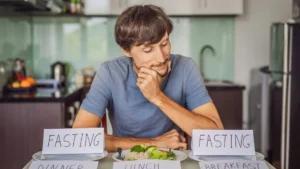
The Weight You Cannot See
Here is the truth that we need to speak plainly, especially to men in 2026.
Fat loss is not just about aesthetics. It is not about having a six-pack for summer. It is about energy levels that let you show up fully — at work, at home, in your relationships. It is about reducing your risk of dying ten years too early. It is about feeling in control of your body at a time when so much else feels out of control.
And yet — intermittent fasting, for all its physical benefits, will not resolve the weight that sits in your chest. The stress you swallow. The emotions you suppress. The conversations you avoid. The loneliness that men in the UK carry silently, year after year.
In 2026, men’s mental health remains in crisis. The Samaritans reports that men account for three in every four suicides in the UK. Men are more likely to turn to alcohol, isolation, or overwork as coping mechanisms than to seek support. Being quiet is not a sign of strength. It is slow erosion.
That is why the work of fasting and the work of emotional health must go hand in hand.
🌱 Ready to Go Deeper? Join Men’s Prosperity Club, Birmingham
Intermittent fasting can transform your body. But what about your mind?
At Men’s Prosperity Club, we believe that real prosperity — the kind that lasts — starts with men taking care of themselves fully. Not just physically, but emotionally, mentally, and spiritually.
We offer a free men’s mental health support space dedicated entirely to men. Whether you are going through a difficult season, feeling disconnected, carrying stress you cannot quite name, or simply looking to grow, this is your space.
What makes us different:
- 🚶 Walk-and-Talk Sessions — We move while we talk. Walking together in the fresh spring air of Birmingham creates a natural, low-pressure environment where conversation flows without the weight of face-to-face intensity.
- 🤝 Horizontal Leadership — There is no hierarchy here. Every man in the room has equal standing, equal voice, and equal worth.
- 💬 Peer Support, Not Therapy — Real men, real conversations, real connection. We hold space for each other without judgment.
- 🔥 A Movement, Not Just a Meeting — Men’s Prosperity Club is bigger than a support group. It is a community of men choosing to be open, authentic, and genuinely present.
This spring, as the blossom returns to Birmingham’s streets and the city breathes again after winter, come and breathe too.
You don’t have to do it all by yourself.