

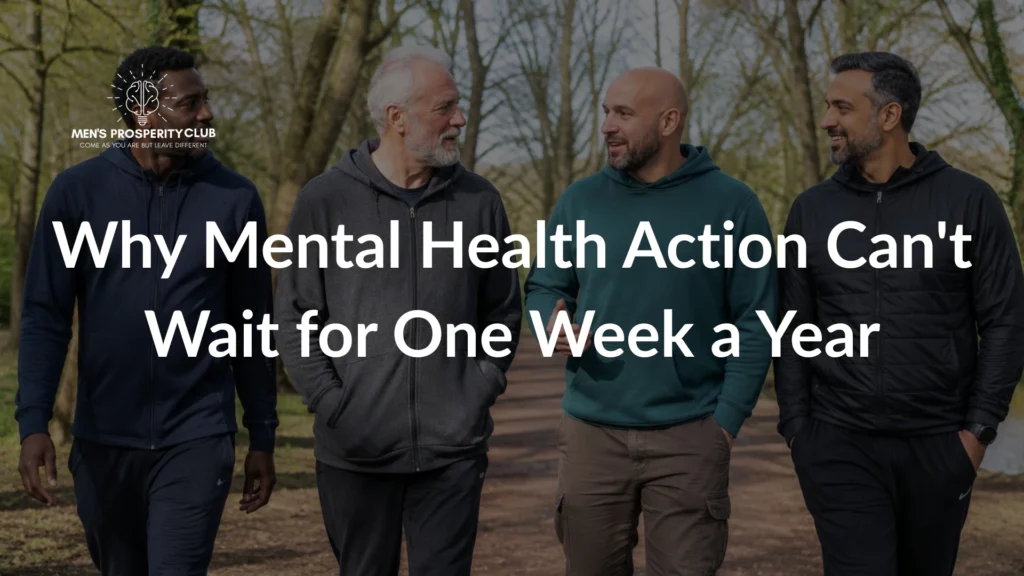
Why Mental Health Action Can’t Wait for One Week a Year
Every May, something remarkable happens across the UK. Conversations that usually stay buried beneath the surface suddenly become visible. Green ribbons appear. Social media feeds fill with honest, courageous stories. Colleagues check in on one another. Families speak openly about things they have never quite found the words for before.
Mental Health Awareness Week is one of the most important moments in the national calendar, and it deserves every bit of the attention it receives. But here is the question worth sitting with once the week is over: what happens on day eight?
Because the truth is, mental health does not take the rest of the year off. Anxiety does not pause because the campaign has ended. Loneliness does not ease because the ribbon has been put away. And the men in your life, the ones who smiled through the week and said they were fine, may still be carrying something heavy in July, in October, in February.
This is not a criticism of awareness campaigns. Awareness is vital and we should never underestimate how far we have come in getting people talking about mental health. But awareness alone is not enough. Real, lasting change happens when we move from understanding to doing. Not just one week a year, but every day.
The Gap Between Awareness and Action
There is a reason mental health charities have started placing action at the centre of their messaging. We live in a country where millions of people are still suffering in silence. Too many are waiting months for professional support. Too many still equate asking for help with admitting weakness. And too many well-meaning people around them do not know what to do.
Awareness can open a door. Action is what walks through it.
This is especially true for men. Research consistently shows that men are less likely to seek help for their mental health, less likely to talk openly about how they are feeling and they are more likely to get really bad before anyone else notices what’s wrong. The stigma is real. The pressure to cope quietly is real. And the consequences, including higher rates of suicide among men, are devastating.
That is why at Men’s Prosperity Club, we believe that action is not a once-a-year commitment. It is a daily practice. It is the small, intentional choices that build resilience, deepen connections and create the kind of life where mental health is genuinely cared for rather than talked about.

Taking Action for Your Own Mental Health
Taking care of your own mental health isn’t selfish. It is essential. You cannot pour from an empty cup, and the better you understand and care for your own wellbeing, the more capacity you will have to show up for the people around you.
Here are some small but meaningful actions you can build into your life year-round:
- Find your one thing. It doesn’t have to be anything big. A daily walk, ten minutes of journalling, reducing screen time before bed, calling a friend you have been meaning to catch up with. Getting stronger through small, consistent habits. Pick one and protect it.
- Talk to someone you trust. Saying out loud that you have been struggling a bit lately is one of the bravest things a person can do. You do not need every answer. You don’t need to break down. Begin the conversation.
- Seek professional support when you need it. If you are experiencing persistent low mood, anxiety or any other mental health difficulty, reach out to your GP or a mental health professional. There’s nothing wrong with asking for help. You can’t do anything stronger than that.
- Practise self-compassion. Many of us are far harder on ourselves than we would ever be on a friend. Notice your inner voice. Is it kind? If not, challenge it. You deserve the same gentleness you would offer to someone you love.
Taking Action for Someone Else
Think about the people in your life right now. Is there someone who appears less talkative than usual? A colleague who has been a little withdrawn? A friend who keeps cancelling plans? A family member who laughs things off but rarely talks about how he is truly feeling?
This week, reach out. Not with a quick message that reads “You ok?” but with something more intentional. Something like, “Hey, I think about you. How are you really doing? I have got time to talk if you need it.”
That word really matters. It means you’re not just going through the motions. You actually want to know.
A few principles worth holding onto when supporting someone who might be struggling:
- Listen more than you speak. When someone shares how they are feeling, resist the urge to fix, advise or compare. Just listen. There is no greater healing experience than being truly heard.
- Check in consistently. Mental health struggles do not resolve after one conversation. Keep showing up.A simple message or an invite for coffee can make all the difference.
- Encourage, do not push. You can gently suggest that someone speak to a professional, but avoid applying pressure or issuing ultimatums. Trust and patience are key.
- Take care of yourself too. It can be emotionally demanding to support someone with their mental health. Make sure you have your own support network in place.

How Workplaces and Communities Can Take Action All Year Round
Mental health doesn’t exist in a vacuum. The environments we live and work in profoundly affect how we feel, and the responsibility for creating psychologically safe spaces does not fall solely on individuals.
There is a unique opportunity for leaders and managers in the workplace. Companies that prioritize mental health foster open cultures, offer Employee Assistance Programs, provide mental health days, and have trained Mental Health First Aiders. These initiatives help employees perform their jobs more effectively, reduce absenteeism, and increase loyalty and engagement within their teams. The question to ask is not whether your organisation talks about mental health during awareness campaigns. The question is whether people feel safe being honest about their wellbeing on an ordinary Tuesday in November.
In communities, connection is a lifeline. Loneliness is one of the biggest risk factors for poor mental health, and no campaign or hashtag can replicate the value of genuine human presence. Whether it is a local sports club, a men’s group, a volunteer programme or a simple standing arrangement to meet a friend for a walk, the threads of community we weave throughout the year matter far more than any single week of visibility.
Individual Action Matters, But It Is Not the Whole Story
Here is something important to sit with: whilst every individual action counts, and please do not underestimate the ripple effect of one person choosing to be kinder, more open or more present, individual action alone will not fix a system that is, in many ways, failing people.
Mental health services across the UK are under enormous strain. In many places, people have to wait too long to get help. Preventive services are underfunded. And the structural factors that drive poor mental health, including poverty, inequality, housing insecurity and unemployment, demand a political and social response alongside personal resilience.
Using your voice matters beyond your immediate circle, too. Supporting campaigns that call for better mental health funding, writing to your MP, and amplifying the stories of people with lived experience are all forms of action. Real change requires real pressure, and every voice adds to the chorus.

What You Can Do Today
You do not need a campaign week to take action. Here are some starting points you can return to at any time of year:
- Check in on someone in your life who might be struggling, and ask how they are really doing
- Identify one positive habit that supports your mental health and commit to it for 30 days
- Have an honest conversation with your manager, your partner or a trusted friend about how you are feeling
- Look into what mental health resources your workplace offers, and encourage others to use them
- Visit the Mental Health Foundation at mentalhealth.org.uk for free resources, tools and guidance
The Bigger Picture: Mental Health as a Daily Practice
There is something quietly powerful about deciding that mental health is not a topic you revisit once a year. That is not a badge you wear in May and put away in June. That it is, instead, woven into the fabric of how you live: the way you speak to yourself, the quality of attention you bring to the people around you and the courage you show in asking for help when you need it.
That is the kind of culture the Men’s Prosperity Club exists to build. A community where men support one another not because a campaign told them to, but because they genuinely understand that strength and vulnerability are not opposites. They’re like two sides of the same coin.
Awareness weeks matter. They spark conversations, shift perceptions and remind us what is at stake. But the work does not end when the week does. The action, your action, starts today and keeps going.
That is not a burden. It is an invitation.