
Money worries keep millions of Britons awake at night. Financial stress doesn’t just empty bank accounts—it damages mental health too. The two feed off each other in a vicious cycle.
When your finances spiral, anxiety follows close behind. Debt creates constant pressure that wears down even the strongest minds. Meanwhile, poor mental health makes managing money feel impossible.
Breaking this cycle requires understanding both sides of the equation. Financial literacy gives you control over money decisions. Good mental health provides the clarity to make those decisions stick.
The Hidden Crisis: Financial Stress and Mental Health in the UK
The numbers tell a worrying story. Over 9 million UK adults struggle with debt they cannot repay. Another 15 million experience daily anxiety about their finances. This silent crisis affects households across Britain.
Financial pressure damages both body and mind. Nearly half of UK adults report worsening health due to money worries. Relationships crack under the strain whilst sleep becomes elusive. Work performance drops as constant worry drains energy and focus.
Young adults face the heaviest burden. Around 66% of those aged 18-34 experience mental health issues from financial stress. Student debt, housing costs, and job insecurity create overwhelming pressure. Many feel trapped, unable to make decisions that could improve their situation.
Understanding the Financial Literacy Gap
Britain faces a serious knowledge problem. Nearly 73% of people fall below the benchmark for adequate financial literacy.
We lag behind France and Canada in money management skills. This gap leaves millions vulnerable to poor financial decisions.
Young people struggle most with basic money concepts. Those aged 16-18 answered just 2.3 questions correctly on financial assessments. People aged 71-80 scored 6.2 on the same test. Schools have failed to teach essential money skills to younger generations.
The consequences reach far beyond test scores. Around 20.3 million UK adults lack confidence managing their money. Without understanding compound interest, inflation, and risk, people make costly mistakes. These errors compound over time, making financial security harder to achieve.

The Vicious Cycle: How Financial Stress Damages Mental Health
Financial stress triggers a destructive loop. Money worries flood your body with stress hormones constantly. One in three people feel anxious about paying bills. One in five cite debt as their main source of anxiety.
Sleep disruption hits first and hits hard. Financial worries keep people awake, creating exhaustion that clouds judgement. Depression and hopelessness follow when debts feel impossible to clear. One in ten UK adults feel completely hopeless about their finances.
The impact shows up in medical claims. Mental health conditions now account for 35% of all income protection claims. This exceeds claims for cancer and musculoskeletal problems combined. Stigma makes things worse as 37% of anxious adults feel too ashamed to talk.
Breaking the Cycle: Building Financial Literacy
Building financial skills breaks the stress cycle. The good news? Anyone can learn these skills with the right approach. Financial literacy means understanding basics, developing habits, and gaining confidence for smart decisions.
Start with the fundamentals. Create a budget to see where your money actually goes. Track spending for one month to spot patterns you might have missed. Small changes in spending habits often yield surprisingly large savings over time.
Understanding debt makes a massive difference. Not all debt costs the same or carries equal risk. Learn which debts to pay first to save the most money. Even modest monthly payments reduce total interest dramatically over a loan’s lifetime.
Men’s Prosperity Club: A Beacon of Support in Birmingham
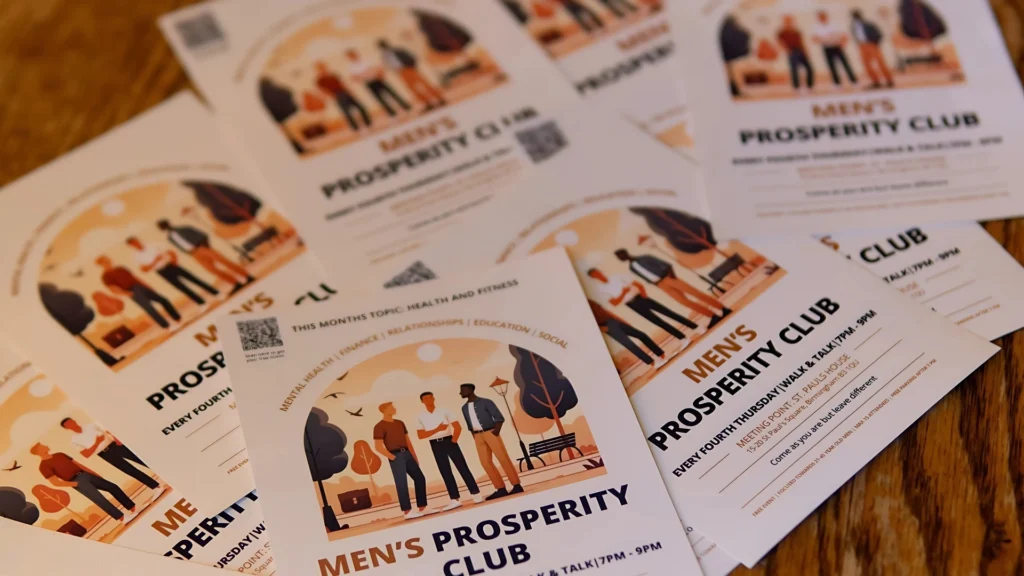
Safe spaces for honest conversations change lives. Men’s Prosperity Club in Birmingham provides exactly that. The organisation offers free mental health support dedicated to men seeking peer support and growth.
The club’s approach centres on monthly walk-and-talk sessions. Every fourth Thursday, participants meet at Saint Paul’s House in Birmingham. Topics include mental health, finances, relationships, faith, and fitness. Walking side-by-side rather than face-to-face helps men open up more easily.
Everyone’s voice matters equally here. The club operates without hierarchy, encouraging genuine dialogue and collaboration. Finance and financial literacy feature prominently in discussions. Members tackle issues they’ve struggled to discuss elsewhere, finding both solace and practical strategies.
Practical Steps Towards Financial and Mental Wellness
Small, consistent actions create lasting change. You don’t need perfection—just progress one step at a time. Start with manageable changes that build momentum and confidence.
First, assess where you stand financially. List all income, expenses, debts, and savings honestly. This snapshot provides essential clarity about your current reality. Then identify one or two areas where immediate improvements seem achievable.
Second, create a realistic budget that works for your life. Allocate money for essentials first—housing, utilities, food, and transport. Address minimum debt payments next. Distribute remaining funds between short-term wants and long-term savings carefully.
The Role of Community and Connection
Isolation makes every problem feel bigger. Community connection provides resilience, perspective, and practical support. Humans thrive when we tackle difficulties together rather than alone.
Peer support groups offer unique benefits. Sharing experiences with others facing similar challenges normalises your struggles. Hearing how others navigated comparable situations provides hope and practical strategies. Helping others whilst receiving support creates purpose and strengthens recovery.
Men’s Prosperity Club shows community power in action. The club believes open, honest conversation makes a real difference. Through consistent participation, members develop genuine friendships extending beyond scheduled meetings. This ongoing connection provides accountability, encouragement, and belonging—all crucial for positive change.

Creating Systemic Change for Lasting Impact
Individual efforts matter, but systemic changes amplify progress across entire populations. Government policy, education reform, and workplace practices all influence financial and mental wellbeing. The financial industry also bears responsibility for treating customers fairly.
Education reform represents a critical starting point. Financial education will become compulsory for all primary school pupils in England. This promises to equip future generations with essential money management skills early. However, teachers need proper training and resources to deliver effective lessons.
Workplace policies significantly impact employee wellbeing too. Offering financial education workshops and confidential debt advice demonstrates genuine care. Fair wages enabling people to meet basic needs reduce financial stress at source. Recent increases in minimum wage help reduce stress for many households.
Looking Forward: Building Your Sustainable Future
Building a sustainable future requires ongoing attention and regular adjustments. Progress rarely follows a straight line upwards. It involves learning from mistakes, celebrating small wins, and maintaining perspective during difficulties.
Starting today matters more than waiting for perfect circumstances. Financial situations rarely improve through passive hope alone. They require active engagement even when facing overwhelming odds. Similarly, mental health benefits from proactive self-care rather than waiting for crisis.
Remember that seeking help demonstrates strength, not weakness. Whether joining Men’s Prosperity Club, calling a debt helpline, or speaking with your GP—reaching out takes courage. Support exists because others have walked similar paths. You deserve support, compassion, and practical assistance during difficult times.
Your Journey Begins Now
The path towards a sustainable future stretches before each of us. Whether you’re struggling with debt, seeking financial literacy, or addressing mental health challenges—resources await you. Support exists in communities across Britain.
The Men’s Prosperity Club continues vital work in Birmingham. The club provides safe spaces for honest conversations about challenges men face. Their mission is simple: to save lives through genuine, transformative conversations. They build a brotherhood embracing every man’s right to open expression and unwavering support.
Across the United Kingdom, millions share similar struggles. You are not alone in this journey. Help exists, hope remains real, and change proves possible. Your sustainable future awaits, built one conversation and one decision at a time.