
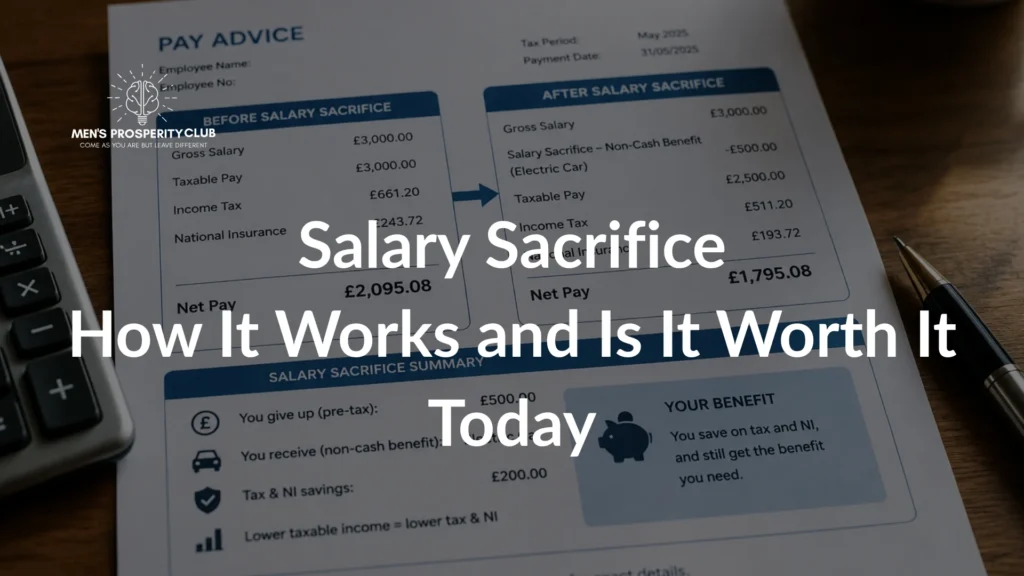
Salary sacrifice is a formal arrangement between you and your employer where you agree to give up part of your gross salary in exchange for a non-cash benefit. Because the sacrifice happens before tax and National Insurance are calculated, both you and your employer pay less to HMRC.
Key Takeaways
- Salary sacrifice reduces your taxable income, meaning you pay less income tax and National Insurance contributions.
- Common benefits include pension contributions, cycle-to-work schemes, electric vehicles, and childcare vouchers.
- Both employees and employers save money, though the arrangement must be agreed in writing and reflected in your contract.
- Higher-rate taxpayers save more, but even basic-rate taxpayers see a meaningful difference over a full tax year.
- There are trade-offs: a lower gross salary can affect mortgage applications, maternity pay, and some state benefits.
- Always check with your HR department or a financial adviser before making any changes to your pay structure.
How Salary Sacrifice Actually Works
The mechanics are straightforward, even if the tax rules around it can feel a little opaque at first.
When you enter into a salary sacrifice arrangement, your employment contract is formally amended to reflect a lower cash salary. Your employer then provides you with a benefit of equivalent value. Because your contractual salary is now lower, both income tax and National Insurance contributions (NICs) are calculated on the reduced figure.
Here is a simple example. Say you earn £40,000 per year and you agree to sacrifice £3,000 annually into your workplace pension through salary sacrifice. Your taxable pay drops to £37,000. As a basic-rate taxpayer, you save 20% income tax plus 8% NICs (in 2024/25) on that £3,000. That is roughly £840 in combined savings per year, simply for redirecting money you were already planning to put into your pension.
Your employer also saves on their National Insurance contributions, which sit at 13.8% of your salary above the secondary threshold. On a £3,000 sacrifice, that is over £400 saved by your employer. Many businesses pass a portion of this saving back to employees as additional pension contributions, which is worth negotiating.
The Paperwork Side
Your employer must amend your contract each time you adjust the arrangement. There is no universal template for this, but HMRC requires that the sacrifice is a genuine reduction in contractual pay, not just a one-off informal agreement. You cannot retroactively sacrifice salary you have already received.
What You Can Actually Claim Through Salary Sacrifice
Not every benefit qualifies, and the list has shifted over the years. HMRC draws a clear distinction between exempt benefits (where no tax or NICs are due) and those treated as taxable benefits-in-kind.
| Benefit | Tax/NIC saving | Key Notes |
|---|---|---|
| Pension contributions | Yes, full | Most widely used; no upper limit on sacrifice amount |
| Cycle-to-work scheme | Yes, full | Bike and equipment up to £1,000 (often higher for e-bikes) |
| Electric vehicle (EV) lease | Yes, full | Benefit-in-kind rate for EVs is 2% in 2024/25 |
| Childcare vouchers | Partial | Closed to new entrants since Oct 2018; existing users can continue |
| Ultra-low emission vehicles | Yes, full | Includes hybrid vehicles under certain thresholds |
| Bus passes / season tickets | Yes, full | Must be employer-arranged |
| Health screenings | Yes, one per year | One annual check covered |
The electric vehicle option deserves special attention right now. With the benefit-in-kind (BiK) rate for fully electric company cars sitting at just 2%, leasing an EV through salary sacrifice is one of the most tax-efficient arrangements available to UK employees. At that rate, even a premium EV comes with a very modest taxable benefit, making it a compelling option for anyone considering switching from a petrol or diesel car.
Pension contributions remain the most popular option. If your employer uses a relief-at-source pension scheme, the interaction between salary sacrifice and tax relief can get complicated, so it is worth speaking to your payroll team before assuming you will receive double relief.

The Real Trade-Offs You Need to Understand
Salary sacrifice is not purely a win. There are legitimate downsides that are often glossed over in HR benefit brochures, and they are worth taking seriously.
Mortgage and credit applications. Lenders assess your income based on your contractual salary. If you are sacrificing £5,000 per year through a pension or EV scheme, some lenders will use the reduced figure when calculating how much they will offer you. This matters most if you are planning to buy a home or remortgage in the near future. Always check with your mortgage broker before entering a long-term arrangement.
Statutory Maternity and Paternity Pay. Both Statutory Maternity Pay (SMP) and Statutory Paternity Pay are calculated on your average weekly earnings. If your contractual salary is lower because of salary sacrifice, your SMP entitlement may be lower too. The same applies to Statutory Sick Pay in some scenarios. This is a particular concern for anyone planning a family.
State Pension entitlement. Your State Pension is linked to your National Insurance record. Because salary sacrifice reduces your NICs, if your adjusted salary drops below the lower earnings limit (£6,396 in 2024/25), you could lose qualifying years for your State Pension. For most workers earning well above this threshold, it is not a concern, but it is worth monitoring if your salary is close to that level.
Flexibility. Most arrangements are set for a fixed period, typically 12 months. You generally cannot exit early without your employer’s agreement, so think carefully before committing to a higher sacrifice amount than you can comfortably manage.
For anyone building a broader picture of their financial wellbeing, the financial fitness money management tips for men in 2025 article covers how to align tools like this with longer-term financial goals.
Salary Sacrifice and Your Mental and Physical Health
There is an often-overlooked connection between financial pressure and personal wellbeing. When you optimise your take-home efficiency through tools like salary sacrifice, you reduce one significant source of stress. Research from the Money and Mental Health Policy Institute (a UK charity) has consistently shown that financial anxiety is one of the most common triggers for poor mental health in working-age adults.
Beyond finances, employer benefit schemes have expanded significantly. Some companies now offer salary sacrifice arrangements for gym memberships, wellbeing apps, and even health screenings. If your employer offers these, they are worth reviewing alongside your pension contributions.
The connection between physical health, mental clarity, and financial resilience is something the blog at Men’s Prosperity Club explores across multiple topics. If you are thinking about your overall health alongside your finances, it is worth considering how they interact. For instance, the sexual link between health and mental well being is one area that illustrates how physical and psychological health reinforce each other in ways that are not always obvious.
Stress and cognitive load also play a role. When you are managing financial uncertainty, your focus and working memory take a hit. Practical strategies for maintaining mental sharpness are covered in brain exercises for better focus and memory in men, which is particularly relevant if you are juggling complex financial decisions alongside a demanding job.
More broadly, men’s health awareness has grown considerably. Initiatives like those discussed in mens mental health day raising awareness and support in birmingham uk and the work explored in why movember matters understanding its impact on mens health highlight that financial wellbeing and mental wellbeing cannot be treated as separate concerns.

Things to Know
- HMRC sets the rules, not your employer. Your employer can choose which benefits to offer, but the tax treatment is governed entirely by HMRC guidance. If a benefit does not qualify, the tax saving disappears.
- You cannot sacrifice below the National Minimum Wage. The arrangement must leave your effective hourly rate at or above the current National Minimum Wage (£11.44 per hour for over-21s from April 2024).
- Your P60 will show the reduced salary. This is the figure used for most official income calculations, including student loan repayments.
- Employer savings can be negotiated. If your employer saves on NICs due to your sacrifice, you can ask for some of that saving to be added to your pension. Not all employers volunteer this information.
- Electric vehicle schemes require a personal lease, not purchase. The vehicle is leased through your employer, not bought. At the end of the term, you return or re-lease it.
- Arrangements must be in writing. A verbal agreement does not satisfy HMRC requirements. Ensure any change is reflected in a formal contract amendment before the next payroll run.
Ready to Review Your Pay Structure?
The single most useful action you can take right now is to request a benefits audit from your HR or payroll team. Ask specifically which salary sacrifice schemes your employer currently offers, whether they pass on NIC savings for pension contributions, and what the minimum sacrifice period is for each benefit. This conversation takes under 30 minutes and could save you hundreds of pounds per year in tax and NICs. If your employer does not currently offer any schemes, you can ask them to set one up, as the process is straightforward for most payroll software systems.

Frequently Asked Questions
Q: Does salary sacrifice affect my tax code?
Your tax code itself does not change, but your taxable income does.
Because the sacrifice reduces your gross pay before tax is calculated, HMRC sees a lower figure and charges tax accordingly. Your tax code remains the same, but the amount you actually pay is lower.
Q: Can my employer refuse to set up a salary sacrifice scheme?
Yes, salary sacrifice is entirely at your employer’s discretion.
There is no legal requirement for employers to offer it. However, given the employer-side NIC savings, many businesses are willing to set up schemes when employees make a clear business case. Larger employers with 50 or more staff are more likely to have established schemes already.
Q: Will salary sacrifice affect my student loan repayments?
Yes, your repayments could decrease.
Student loan deductions in the UK are based on your gross taxable income above the relevant threshold (Plan 1: £26,900; Plan 2: £29,385 for 2026/27). If salary sacrifice brings your pay below those thresholds, your repayment amount falls. This is a legitimate outcome, not a loophole.
Q: Is there a limit on how much I can sacrifice?
There is no HMRC cap on the amount you sacrifice, but practical limits apply.
Your reduced salary cannot fall below the National Minimum Wage, and for pensions, the annual allowance of £60,000 (or 100% of earnings, whichever is lower) caps total pension contributions from all sources combined.
Q: Can I use salary sacrifice if I am self-employed?
No, salary sacrifice is only available to employees on a PAYE payroll.
Self-employed individuals pay Class 4 NICs directly through Self Assessment and do not have an employer to facilitate the arrangement. Sole traders and directors of their own limited companies need to consider alternative tax-efficient options such as employer pension contributions directly from the company.
The Bottom Line on Salary Sacrifice
Used correctly, salary sacrifice is one of the most accessible tax-efficiency tools available to UK employees. It does not require a financial adviser to set up, the savings are immediate, and the range of qualifying benefits is broader than most people realise.
The key is to go in with a clear picture of the trade-offs. Check how a reduced contractual salary affects any financial applications you have planned, be mindful of the impact on statutory pay if your family circumstances might change, and always get the arrangement documented properly. Once those boxes are ticked, there is a strong case for making the most of every scheme your employer offers.