

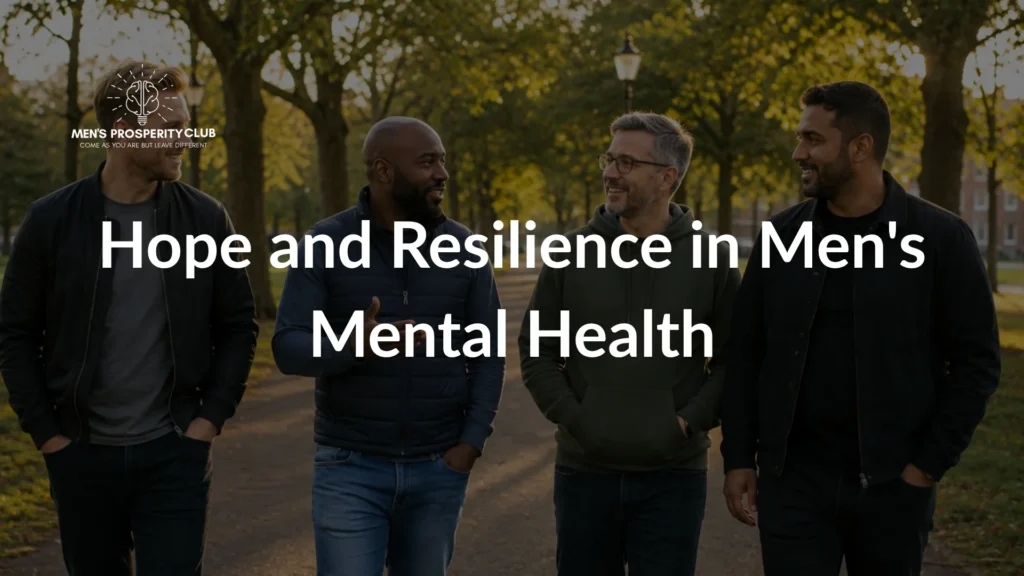
Hope and resilience are not abstract ideals. They are practical, learnable qualities that shape how men respond to adversity, setbacks and uncertainty across every area of life.
Table of Contents
- Why These Qualities Matter More Than Ever for Men
- What Hope Actually Looks Like in Practice
- Building Resilience: The Real Work Behind It
- The Role of Community in Strengthening Both
- Physical Wellbeing and Its Connection to Mental Strength
- Practical Strategies Men Can Start Using Today
- How Men’s Prosperity Club Supports This Journey
Key Takeaways
- Hope and resilience are skills that can be developed, not fixed personality traits some men are born with.
- Isolation is one of the biggest barriers to building resilience, making community connection essential.
- Physical activity, honest conversation and purposeful goal-setting all contribute meaningfully to mental strength.
- Men do not have to experience a crisis before seeking support or joining a community.
- Acknowledging difficulty is not weakness; it is the starting point for genuine growth.
- Peer support from men with shared experiences is one of the most effective tools for building long-term emotional wellbeing.
Why These Qualities Matter More Than Ever for Men
Mental health challenges among men in the United Kingdom remain significantly underreported. According to NHS England’s mental health statistics, men are far less likely than women to seek help for psychological distress, yet they account for approximately three-quarters of all deaths by suicide in England and Wales each year. These figures point to a cultural gap, one where men are often conditioned to manage pain silently rather than process it openly.
This is precisely where hope and resilience become so important. Without a genuine sense that things can improve, men can become trapped in cycles of avoidance, withdrawal and self-reliance that ultimately make their situations worse. Resilience, in particular, is frequently misunderstood. It is not about toughening up, suppressing emotion or pushing through pain without acknowledging it. Rather, it is the capacity to adapt, recover and find meaning after difficulty and that capacity is built over time through experience, connection and reflection.
The Mental Health Foundation highlights that strong social relationships are among the most consistent predictors of psychological resilience in adults and exploring the sexual link between health and mental well being is one often-overlooked dimension of how men experience overall wellbeing. For men who have been socialised to avoid vulnerability, this insight carries particular weight. Connection is not a luxury. It is a cornerstone of mental strength.
What Hope Actually Looks Like in Practice
Hope is often portrayed in sweeping, inspirational terms that feel disconnected from everyday life. In reality, hope functions more like a practical framework. Psychologists often describe it in terms of two components: the belief that a better future is possible and the conviction that one has the ability to work towards it. Both are necessary. One without the other tends to produce either passive wishing or anxious striving.
For men navigating job loss, relationship breakdown, financial pressure or health concerns, cultivating genuine hope means first acknowledging that the current situation is difficult, without catastrophising it as permanent. It means identifying even small steps that move in a positive direction and finding people or environments that reinforce the belief that progress is achievable.
Reading through the blog at Men’s Prosperity Club provides a useful starting point for men exploring how these themes show up in daily life, from managing financial pressure to improving relationships and building healthier habits.
Hope also has a cognitive dimension. The way men talk to themselves in moments of stress shapes how they interpret setbacks. A man who tells himself he has always been resilient will process failure differently from a man who believes he is fundamentally incapable. This is not about toxic positivity or dismissing real difficulty. It is about developing an honest, balanced inner narrative that leaves room for growth.
Building Resilience: The Real Work Behind It
Resilience is built through repeated exposure to manageable challenge, not through the absence of difficulty. This is a crucial distinction. Men who have never been given the opportunity to sit with discomfort, process it and come through the other side often struggle more when significant challenges arise. The capacity to bounce back is, in many ways, a muscle that requires regular exercise.
Several evidence-based approaches consistently support the development of resilience in men:
- Honest conversation: Talking openly about struggles, rather than minimising them, reduces their psychological weight and builds perspective.
- Purposeful goal-setting: Having clear, realistic goals gives men a sense of direction and agency, even when broader circumstances feel uncertain.
- Routine and structure: Consistent daily habits provide psychological stability during turbulent periods.
- Cognitive reframing: Learning to identify unhelpful thought patterns and consciously choosing more balanced interpretations of events.
- Rest and recovery: Sleep, downtime and non-productive time are not indulgences. They are necessary conditions for mental restoration.
The ONS wellbeing data for England consistently shows that men with strong social networks and a sense of purpose report higher levels of personal wellbeing, even when facing objective difficulties such as financial hardship or health challenges and improving mental clarity through brain exercises for better focus and memory in men can further strengthen a man’s capacity to think through problems effectively. This suggests that resilience is heavily mediated by context and that context can be changed.

The Role of Community in Strengthening Both
No man builds resilience in isolation. The research is clear on this point and lived experience tends to confirm it. Men who feel part of a community, who have people they can speak honestly to without fear of judgement, consistently demonstrate stronger recovery from adversity than those who rely entirely on self-sufficiency.
This is one of the reasons why initiatives like mens mental health day raising awareness and support in birmingham uk carry genuine significance. Awareness days do not exist merely for symbolism. They create openings for conversations that many men would never initiate on their own. They normalise the idea that asking for support is a reasonable, rational and even courageous act.
Men’s Prosperity Club was built on this understanding. The organisation functions not as a clinical service but as a peer-led community where men from all backgrounds in Birmingham can come together, share experiences and support one another through honest conversation. The model recognises that men are more likely to open up when they feel genuinely respected and understood, particularly by other men who have faced similar challenges.
Brotherhood, in the MPC context, is not a vague aspiration. It is a practical framework for reducing isolation, building accountability and creating the kind of relationships that sustain men through hard times. The organisation’s walk-and-talk sessions, in particular, offer a format that many men find less daunting than formal group therapy, allowing conversation to emerge naturally through shared activity and movement.
Why Movember matters understanding its impact on mens health explores how campaigns built around male solidarity can shift cultural attitudes and encourage men to take their health, both physical and mental, more seriously.
Physical Wellbeing and Its Connection to Mental Strength
The relationship between physical health and psychological resilience is well established. Regular movement, adequate sleep and balanced nutrition all contribute to the neurochemical conditions that support emotional regulation, stress recovery and cognitive clarity. For men looking to build hope and resilience, the body is not separate from the mind. It is part of the same system.
Exercise, in particular, has a meaningful impact on mood and mental endurance. It is not simply about fitness goals. Movement reduces the physiological stress response, supports better sleep and provides a sense of accomplishment that can translate into broader psychological confidence.
The connection between physical health and mental wellbeing extends further than many men realise and understanding how to build financial fitness money management tips for men in 2025 is another important dimension of overall resilience that affects men’s stress levels and sense of control. Ignoring these connections does not make them less influential.
Cognitive health also plays a role. Practising brain exercises for better focus and memory in men can sharpen mental clarity and improve a man’s capacity to think through problems calmly, which directly supports both decision-making under pressure and long-term resilience.

Practical Strategies Men Can Start Using Today
Understanding hope and resilience intellectually is useful. Applying that understanding through consistent daily action is where change actually happens. The following approaches are grounded in broadly accepted psychological principles and can be integrated gradually rather than all at once:
Start small and build consistency. Large behavioural changes rarely stick. A 15-minute walk, a short conversation with a trusted friend or five minutes of quiet reflection each morning can form the foundation of habits that compound over time.
Seek peer connection deliberately. Resilience is not built in solitude. Finding a community, whether online or in person, where honest conversation is possible makes a significant difference to long-term emotional stability.
Address financial stress proactively. Money worries are among the most common contributors to poor mental health in men across the United Kingdom. Financial fitness money management tips for men in 2025 offers practical guidance for men working to reduce financial anxiety and build a more secure foundation for their lives.
Recognise progress, not just outcomes. Men often measure themselves against final results and dismiss incremental improvement. Acknowledging small steps builds the internal evidence that change is possible, which is the cognitive foundation of hope.
Limit comparison. Social media and cultural narratives about male success create unrealistic benchmarks. Resilience grows when men evaluate their progress against their own history rather than an external standard.
The Guardian’s coverage of men’s mental health regularly highlights the real-world impact of these challenges and the communities working to address them, offering further context for men who want to understand the broader landscape.

How Men’s Prosperity Club Supports This Journey
Men’s Prosperity Club exists specifically to help men in Birmingham build the kind of internal and relational resources that sustain them through life’s challenges. The organisation offers a free, judgement-free environment where men can discuss what is actually going on in their lives, without pressure to perform, minimise or have everything figured out.
The MPC model covers a broad range of areas that affect men’s overall wellbeing, including mental health, relationships, finance, fitness, faith and personal development. This breadth reflects a recognition that men’s lives do not fit into neat categories. A financial difficulty often affects a relationship. A relationship breakdown affects focus and productivity. Physical health influences emotional regulation. Everything is connected.
Through peer support sessions, community discussions, walk-and-talk events and personal development workshops, MPC creates the conditions in which hope and resilience can genuinely develop. Not through programmes or prescriptions, but through belonging, honest conversation and shared experience.
As the World Health Organization notes on mental health, social inclusion and community connectedness are among the most protective factors for mental health across all demographics. MPC embodies this principle in a form built specifically around the needs and realities of men.
Men in Birmingham who are ready to take a step towards stronger mental wellbeing do not need to have it all worked out before joining. They simply need to show up.
Things to Know
- Hope and resilience are not permanent states that men either have or lack. They fluctuate depending on circumstances, support systems and daily habits, which means they can always be rebuilt.
- Many men confuse resilience with emotional suppression. True resilience involves processing difficulty, not bypassing it. Men who consistently push feelings down without addressing them tend to experience burnout, not strength.
- Community support does not require a man to be in crisis. Men’s Prosperity Club welcomes members at any stage of life, whether they are struggling significantly or simply looking for meaningful connection and growth.
- Financial stress is one of the most underacknowledged contributors to poor mental health in men across the United Kingdom. Addressing money worries is a legitimate and important part of building overall resilience.
- The quality of a man’s relationships, at home, at work and within his wider community, has a measurable impact on how he handles adversity. Investing in those relationships during good times builds the reserves needed during hard ones.
- Seeking support early, before a situation becomes a crisis, is consistently more effective than waiting until things reach a breaking point. Small, timely conversations can prevent much larger struggles later.
Join a Community That Has Your Back in Birmingham
Men’s Prosperity Club is a free, judgement-free space in Birmingham built specifically for men who want to talk honestly, connect genuinely and grow personally. Whether life feels manageable right now or genuinely difficult, the community is there to walk alongside men at every stage of the journey. Real conversations, real brotherhood and real support are available without cost or pressure.
If you are a man in Birmingham looking for a community where you can speak openly, build meaningful connections and develop the resilience to face whatever life brings, Men’s Prosperity Club is ready to welcome you. Take the first step by reaching out to Men’s Prosperity Club directly and finding out when the next session is taking place near you.
Frequently Asked Questions
Q: What is the difference between hope and resilience and do men need both?
Hope and resilience are related but distinct qualities: hope is the belief that a better future is possible, while resilience is the capacity to recover and adapt after difficulty.
Both matter because one without the other tends to be insufficient. A man with hope but no resilience may struggle to take consistent action when faced with setbacks. A man with resilience but no hope may endure hardship without any sense of direction or purpose. Together, they create a psychological foundation that helps men move through challenges without losing sight of what they are working towards.
Q: Can resilience be learned, or is it something men are simply born with?
Resilience is widely understood to be a learnable quality, not a fixed trait determined by personality or genetics.
Research consistently shows that resilience develops through experience, supportive relationships, honest self-reflection and consistent habits. Men who have faced significant adversity early in life are not automatically more resilient; what matters is how those experiences were processed and what support was available. This means that any man, at any age, can take deliberate steps to build greater emotional strength and adaptability over time.
Q: How does talking to other men actually help with building hope and resilience?
Peer conversation reduces isolation, provides perspective and creates a sense of shared humanity that is difficult to replicate through solitary effort alone.
When men hear others articulate struggles they have quietly carried themselves, it normalises those experiences and reduces the shame that often surrounds them. This shift in perspective is one of the most powerful catalysts for hope. Knowing that other men have faced similar situations and found a way through them provides concrete evidence that recovery and growth are possible. Men’s Prosperity Club is built on precisely this principle, creating a space where honest conversation becomes a tool for genuine change.
Q: What should a man do if he feels he has lost all sense of hope?
Reaching out to another person, whether a trusted friend, a peer support group or a professional, is the most important first step when hope feels completely out of reach.
Feelings of hopelessness are a recognised feature of several mental health conditions, including depression and they tend to intensify when a man is isolated. The belief that nothing will improve is a symptom, not an accurate prediction of the future. Speaking to a GP is always a sound starting point if the feelings are persistent and the NHS Every Mind Matters resource offers practical tools for men navigating low mood. Community support through organisations like Men’s Prosperity Club can also provide meaningful human connection during periods when hope feels distant.
Q: Is Men’s Prosperity Club only for men who are struggling with serious mental health issues?
Men’s Prosperity Club is open to all men in Birmingham, regardless of whether they are in crisis or simply looking for connection, personal growth and a stronger sense of community.
The organisation does not operate as a clinical service and does not require members to meet a particular threshold of difficulty before they are welcome. Many members join because they want meaningful friendships, accountability or a space to discuss life openly rather than because they are in acute distress. MPC is designed to serve men across the full spectrum of experience, from those navigating significant challenges to those who simply want to live with greater purpose and connection.
The Bottom Line on Hope and Resilience
Hope and resilience are not destinations that men arrive at once and maintain without effort. They are ongoing practices, shaped by the conversations men have, the communities they belong to and the habits they build into their daily lives. For men in Birmingham, Men’s Prosperity Club offers a tangible, accessible and free way to start building both, surrounded by other men who understand the journey from the inside.
The most important thing any man can do is take the first step. That might mean attending a walk-and-talk session, joining a community discussion or simply reading more about what support is available. Whatever the starting point, the direction matters far more than the pace. Reach out to Men’s Prosperity Club today and take that first step towards a stronger, more connected version of yourself.