
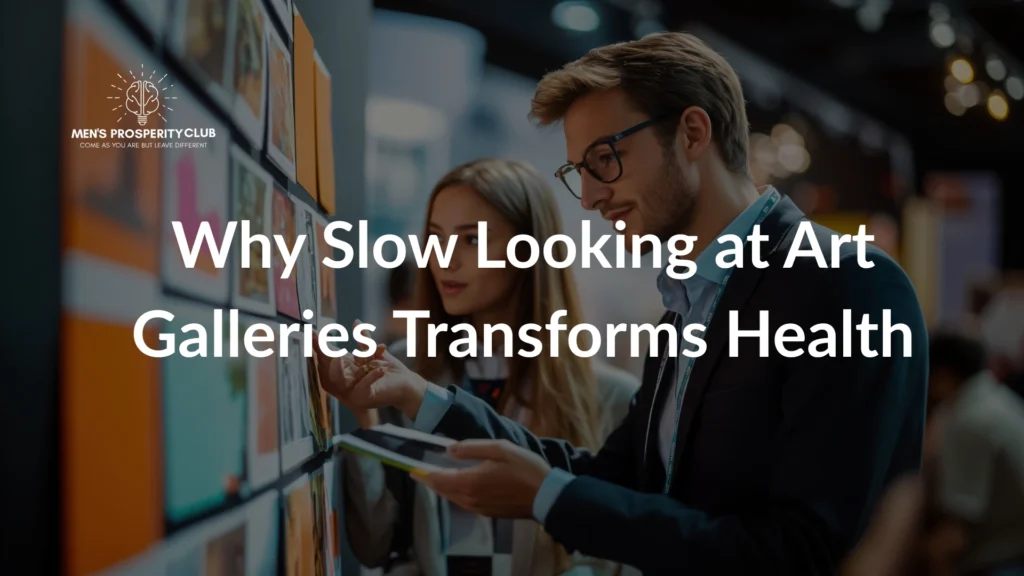
When was the last time you stood in front of a painting for more than thirty seconds? If you’re like most gallery visitors, you probably breezed through the last exhibition you attended, snapping a few photos and moving swiftly from one masterpiece to the next. But what if you’re missing something profound by rushing through?
Recent research reveals that deliberately slowing down whilst viewing art delivers remarkable mental and physical health benefits. This practice, known as “slow looking,” transforms a quick gallery visit into a therapeutic experience that calms your body, quiets your mind, and rewires your brain for better wellbeing.
The Science Behind Slowing Down
Here’s something extraordinary: when you spend extended time viewing original artwork in a gallery, your body responds in measurable ways. A groundbreaking study from King’s College London recently discovered that viewing original art reduces cortisol—the stress hormone—by an impressive 22%, compared to just 8% when viewing reproductions of the same paintings. Even more remarkably, inflammatory markers linked to heart disease, diabetes, anxiety, and depression dropped by 30% for those viewing authentic artwork.
Dr Tony Woods, who led this research at The Courtauld Gallery, describes the experience as a “cultural workout for the body.” Your heart rate increases slightly, showing emotional engagement, whilst simultaneously your stress responses decrease. It’s a unique combination that leaves you both energised and calm.
Moreover, data from 23,660 people in the UK Understanding Society survey confirms that regular arts engagement significantly improves mental health functioning and life satisfaction. Those who engaged with arts more than once weekly reported notably lower mental distress than infrequent participants.
What Exactly Is Slow Looking?
Simply put, slow looking means giving an artwork your undivided attention for an extended period—perhaps five uninterrupted minutes, though some people spend hours with a single piece. Instead of glancing briefly and moving on, you settle in. You notice details you’d otherwise miss. You let your mind wander. You discover layers of meaning that only reveal themselves with time.
Crucially, this isn’t about forcing concentration or analysing every brushstroke academically. Rather, it’s about allowing yourself to truly see without rushing. Think of it as meditation with your eyes open—but instead of focusing inward, you’re immersing yourself in beauty.
Cima Azzam, a curator at Maraya Art Centre, explains that slow looking creates space to appreciate the artistic process itself. “Art is a language of its own,” she says. “Taking time to look intently, allowing your eyes to wander, sparks a genuine connection.”
The Mood-Boosting Magic of Extended Viewing
Beyond the physical benefits, slow looking delivers immediate psychological rewards. Research published in Psychology of Aesthetics, Creativity, and the Arts found that extended art viewing produces significant short-term mood improvements. Participants consistently reported feeling more pleasant and relaxed after spending prolonged periods with artworks.
Interestingly, the study also revealed that providing art historical context during viewing enhanced cultural understanding and engagement more effectively than meditation-based approaches. This suggests that learning whilst looking amplifies the benefits—though the looking itself remains the essential ingredient.
Furthermore, the research showed that representational artworks (paintings depicting recognisable subjects) generated higher enjoyment scores than abstract pieces for most viewers. So if you’re new to slow looking, starting with figurative paintings might make the practice more accessible and rewarding.
Why Modern Life Desperately Needs This Practice
Let’s be honest: our attention spans are under constant assault. Between doomscrolling on social media, juggling work demands, and managing daily responsibilities, our brains rarely get a moment’s peace. We’re perpetually distracted, overstimulated, and rushing from one thing to the next.
Slow looking offers an antidote to this frantic pace. Tina Chummun, a psychotherapist accredited by the UK Council for Psychotherapy, calls it a “rewilding of attention.” When you practise slow looking, you activate your prefrontal cortex—the brain region responsible for focus and emotional regulation—whilst simultaneously calming your amygdala, which triggers stress responses.
This shift activates your parasympathetic nervous system, moving you into “rest and digest” mode. Your cortisol levels drop, your breathing deepens, and your body releases tension you didn’t even realise you were holding. It’s like pressing a reset button for your overworked nervous system.
Making Slow Looking Work in Galleries
Ready to try it? Start by choosing a quieter time to visit galleries. Weekday mornings or late afternoons typically see fewer crowds, allowing you to settle in front of an artwork without feeling rushed or self-conscious.
When you find a piece that speaks to you—even if you can’t articulate why—stop. Plant your feet. Set a gentle intention to stay for at least five minutes. At first, this might feel awkward or even boring. That’s completely normal. Our brains crave constant stimulation, and sitting still contradicts everything modern life teaches us.
Initially, let your eyes roam freely across the artwork. Notice colours, shapes, and textures. Then, zoom in on details. What’s happening in the shadows? How does the light fall? What emotions does the painting evoke? After a few minutes, zoom back out and see the piece afresh. You’ll be astonished by what emerges when you give art—and yourself—time to breathe.
If you find your mind wandering to your to-do list or dinner plans, gently guide your attention back without judgement. This is part of the practice. Each time you return your focus to the artwork, you’re strengthening your attention muscles.
Bringing Slow Looking into Daily Life
Whilst galleries provide ideal settings for slow looking, you needn’t wait for your next exhibition visit to reap the benefits. The principles apply beautifully to everyday moments, transforming mundane activities into opportunities for presence and peace.
Tina suggests weaving small rituals into activities you already do. “Study the texture of your morning toast,” she recommends. “Trace the lines on a loved one’s face. Watch how light shifts on the wall throughout the afternoon.” These tiny practices accumulate, gradually training your brain to notice beauty in ordinary moments.
Consider your daily commute. Instead of immediately reaching for your phone, try gazing out the window during your train journey. Watch the landscape unfold. Notice the play of clouds, the changing architecture, the way trees bend in the wind. This isn’t wasting time—it’s reclaiming your attention from the digital void.
Similarly, if you garden, pause during your work. Really observe the plants you’re tending. Notice their colours, the way leaves catch sunlight, the intricate patterns in petals. Or simply sit on a garden swing and let the gentle rocking motion soothe your vestibular system, which Tina notes has “strong links to autonomic regulation, balance, and even our sense of time.”
The Hidden Benefits for Loneliness and Connection
Here’s something fascinating: even if you visit a gallery alone, slow looking creates unexpected social benefits. Katherine Templar Lewis, a cognitive scientist and co-founder of neuroaesthetic studio Kinda Studios, explains that people in galleries naturally move in synchronicity. You pause at similar moments. You walk together through rooms. You share silent appreciation with strangers.
Your body registers these subtle social connections, countering loneliness’s damaging effects. This communal experience, combined with the mental stimulation of engaging with art, also helps protect against dementia. Research from University College London found that adults over 50 who visit museums regularly have lower dementia rates than those who don’t.
Additionally, analysis of UK museum visitors shows we’re increasingly embracing this slower approach. Between January and March this year, Britons made around 10 million visits to museums and galleries—up 11% from the previous year. Crucially, observers note more visitors settling into single galleries for extended periods, completely absorbed and unaffected by surrounding crowds.
The Transformative Power of Presence
Ultimately, slow looking isn’t really about art at all. It’s about reclaiming your capacity for sustained attention, wonder, and presence. In a culture obsessed with productivity and efficiency, deliberately choosing to simply observe—without agenda or outcome—becomes a radical act.
When you practise slow looking, you’re not trying to extract information or tick boxes. You’re not proving anything or performing for social media. Instead, you become what Tina calls “the witness.” You see without judging. You experience without analysing. You exist, fully, in the present moment.
This shift creates space for new thoughts, feelings, and insights to surface naturally. You might notice subtle environmental details you’d typically miss—leaves rustling, birds overhead, rain’s gentle rhythm. You might access deeper emotions or memories. You might simply feel calm for the first time in weeks.
Recent data confirms these profound effects. A survey of 2,000 Jackson’s art supply customers found that 21% reported feeling deeply relaxed through art engagement, whilst 20% experienced boosted confidence and self-esteem. Significantly, 9% found that creative activities reduced anxiety and depression symptoms. Though nearly half of the UK public (47%) believes taking up artistic hobbies would benefit their mental health, currently only 15% actively engage with art regularly.
This gap reveals a tremendous opportunity. You don’t need artistic talent to benefit from slow looking. You needn’t create anything. Simply showing up, slowing down, and truly seeing brings remarkable rewards.
Starting Your Practice Today
Begin small. You might start by spending just three minutes with a single artwork at your next gallery visit. Or perhaps try observing clouds for five minutes during your lunch break. Notice what happens to your breathing, your shoulders, your racing thoughts.
Over time, you can extend these moments. Maybe work up to ten minutes with an artwork, or dedicate your entire train journey to gazing out the window without your phone. The key isn’t duration—it’s intentionality. Even brief moments of slow looking interrupt our culture’s relentless pace and remind your nervous system that it’s safe to rest.
Remember, this practice takes time to develop. Our brains have been trained to seek constant stimulation, so sitting still initially feels uncomfortable. That discomfort isn’t failure—it’s simply your attention span rewilding itself. Each time you practise, you’re literally rewiring your brain for greater calm, focus, and presence.
In a world that constantly demands more, faster, now, slow looking offers something revolutionary: permission to simply be. To observe without purpose. To exist without agenda. And in that simple act of slowing down, you might discover that the greatest masterpiece isn’t hanging on a gallery wall—it’s the unfolding beauty of each present moment, waiting patiently for you to finally notice.