
Let’s be honest—most of us weren’t taught how to navigate our emotions growing up, especially when it comes to relationships. Yet, here we are, trying to build meaningful connections whilst struggling to understand why our partner seems frustrated, or why a simple conversation escalates into an argument. Sound familiar?
The answer often lies in something we rarely discuss openly: emotional intelligence. It’s not just psychology jargon or corporate buzzword—it’s the fundamental skill that determines whether our relationships thrive or merely survive.
Understanding Emotional Intelligence: More Than Just Feelings
Before we dive deeper, let’s clarify what emotional intelligence actually means. Simply put, it’s your ability to recognise, understand, and manage your own emotions whilst also being aware of and responding appropriately to the emotions of others.
Think of it as your emotional GPS. Without it, you’re navigating relationships blindfolded, hoping you won’t crash into misunderstandings, resentment, or distance.
According to research from the Mental Health Foundation UK (2025), approximately 74% of adults believe that emotional awareness significantly impacts relationship satisfaction. Moreover, couples who actively develop emotional intelligence skills report 42% higher relationship quality scores compared to those who don’t.
These aren’t just numbers—they represent real people, real relationships, and real transformations.
The Four Pillars of Emotional Intelligence in Relationships
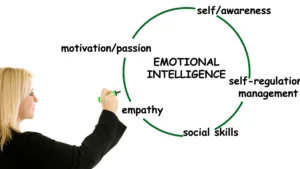
1. Self-Awareness: Knowing Yourself First
You can’t truly connect with someone else if you don’t understand yourself. Self-awareness means recognising your emotional triggers, understanding your communication patterns, and acknowledging your needs without shame.
For instance, perhaps you shut down during conflict because that’s how you learned to cope growing up. Or maybe you become defensive when receiving feedback because criticism feels like rejection. The first step toward change is to see these patterns.
Furthermore, self-awareness helps you take responsibility for your emotional responses. Instead of blaming your partner for “making you angry,” you begin to understand that whilst they may have triggered the emotion, how you respond remains within your control.
2. Self-Management: Responding Rather Than Reacting
Here’s where emotional intelligence becomes practical. Once you’re aware of your emotions, the next challenge is managing them effectively.
This doesn’t mean suppressing feelings or pretending everything’s fine when it isn’t. Rather, it means creating space between feeling and action. It’s choosing to take a breath before snapping back during an argument. It’s recognising when you need a moment alone before continuing a difficult conversation.
Interestingly, data from Relate UK (2025) shows that couples who practise emotional regulation techniques experience 58% fewer recurring conflicts. That’s because they’re addressing actual issues rather than just reacting to emotional overwhelm.
3. Social Awareness: Reading the Room (and Your Partner)
Emotional intelligence isn’t a solo act—it’s deeply relational. Social awareness involves picking up on your partner’s emotional cues, even when they’re not explicitly stated.
Notice the sigh when they walk through the door. Recognise the forced smile hiding disappointment. See beyond the “I’m fine” to understand what they’re genuinely feeling.
This skill becomes particularly vital during challenging times. When your partner is struggling, they may not always have the words to express what they need. Your ability to sense their emotional state and respond with empathy can make all the difference.
4. Relationship Management: Putting It All Together
This is where everything converges. Relationship management means using your emotional intelligence to navigate conflicts constructively, communicate effectively, and build deeper intimacy.
It’s choosing curiosity over judgment when your partner does something you don’t understand. It’s apologising genuinely when you’ve caused hurt, even if it wasn’t intentional. It’s celebrating their successes without letting your own insecurities create distance.
Why Emotional Intelligence Matters Now More Than Ever
We’re living through unprecedented times. Mental health challenges are rising, with the Office for National Statistics (2025) reporting that 1 in 5 UK adults experience symptoms of depression or anxiety. These struggles inevitably impact our relationships.
Additionally, modern life keeps us chronically disconnected despite constant digital connection. We’re busier, more stressed, and often emotionally depleted. Without emotional intelligence, relationships become another source of stress rather than a refuge from it.
However, there’s hope. Research from the University of Cambridge (2025) demonstrates that emotional intelligence skills can be developed at any age. You’re not stuck with the emotional toolkit you were handed in childhood—you can build new skills, create healthier patterns, and transform your relationships.
The Real-World Impact: What Changes When Emotional Intelligence Improves
Let me paint you a picture. Imagine coming home after a difficult day. Previously, you might have withdrawn or snapped at your partner over something trivial. Now, with greater emotional intelligence, you recognise that you’re stressed and need support.
Instead of creating conflict, you communicate: “I’ve had a rough day and I’m feeling overwhelmed. Could we just sit together for a bit?” Your partner, who is also emotionally aware, is present instead of trying to fix things.
This seemingly small shift creates profound change. Conflict decreases. Intimacy deepens. Both partners feel seen, heard, and valued.
Moreover, emotional intelligence creates a ripple effect. When you develop these skills, you model them for your children, friends, and colleagues. You contribute to creating emotionally healthier communities.
Breaking Down the Barriers: Why Men Struggle with Emotional Intelligence
Traditionally, many men have been socialised to suppress emotions, viewing vulnerability as weakness. We’re taught to “man up,” to solve problems rather than feel them, to maintain stoic strength regardless of our internal struggles.
This conditioning creates significant barriers to developing emotional intelligence. How can you understand emotions you’ve been trained to ignore? How can you communicate feelings you’ve learned to suppress?
The consequences are devastating. Statistics from the Samaritans (2025) reveal that men remain three times more likely to die by suicide than women, with poor emotional literacy being a significant contributing factor.
Fortunately, this narrative is changing. More men are recognising that emotional intelligence isn’t weakness—it’s essential strength. It’s the courage to be vulnerable, the wisdom to seek support, and the commitment to continuous growth.
Finding Support: You Don’t Have to Navigate This Alone
Developing emotional intelligence is challenging work, particularly if you’re starting from scratch. That’s why community matters so much.
Men’s Prosperity Club Birmingham and Worcestershire offers a free mental health support space specifically designed for men seeking peer support, personal growth, and genuine community connection. This isn’t just another support group—it’s a movement encouraging men to express themselves openly and authentically.
Through unique walk-and-talk sessions and a horizontal leadership model, we’ve created a safe space where vulnerability is embraced as strength. Here, you’ll discover that you’re not alone in your struggles. Other men understand the challenges you’re facing because they’re navigating them too.
The horizontal leadership model means there’s no hierarchy, no judgment, no pressure to perform masculinity in any particular way. Instead, there’s mutual support, shared wisdom, and collective growth.
These walk-and-talk sessions are particularly powerful. Moving whilst talking reduces the intensity of eye contact, making it easier to open up about difficult emotions. Nature provides a calming backdrop, helping you process feelings without becoming overwhelmed.
Taking Action: Your Next Steps Toward Emotional Growth
Reading about emotional intelligence is valuable, but transformation requires action. Here’s what you can do starting today:
First, begin noticing your emotions without judgment. When you feel something, simply name it: “I’m feeling anxious,” “I’m feeling frustrated,” “I’m feeling disappointed.” This simple practice builds self-awareness.
Second, create space before responding in emotionally charged situations. Count to ten. Take three deep breaths. Walk around the block. Permit yourself to respond thoughtfully rather than reactively.
Third, practice empathy daily. When your partner shares something, resist the urge to immediately offer solutions. Instead, just listen and say something like, “That sounds really hard,” or “I can see why you’d feel that way.”
Finally, seek community. Emotional intelligence develops best in relationship with others who are committed to the same growth.

Your Invitation to Transform
Emotional intelligence isn’t just important in relationships—it’s absolutely essential. It’s the difference between connection and disconnection, intimacy and isolation, growth and stagnation.
You deserve relationships that feel nourishing rather than draining. Your partner deserves the full, emotionally present version of you. Your future self will thank you for doing this work now.
Join Men’s Prosperity Club today. Take the first step toward developing the emotional intelligence that will transform not just your relationships, but your entire life. Together, we’re creating a community where men support men, where vulnerability is valued, and where genuine prosperity—emotional, relational, and personal—becomes possible.
Because at the end of the day, the most important relationship skill isn’t communication technique or conflict resolution strategy—it’s the courage to show up fully as yourself, emotions and all.
Ready to begin your journey? Connect with Men’s Prosperity Club and discover the power of community, the strength in vulnerability, and the transformation that’s waiting for you.
Your relationships—and your life—will never be the same.