


You just got promoted. Your boss praised your work in front of the whole team. Your colleagues look to you for answers. And yet — late at night, or maybe right before a big meeting — a voice creeps in and whispers: “You don’t actually deserve this. Sooner or later, they’re going to find out.”
If that sounds familiar, you are not broken. You are not alone. And you are not a fraud.
What you are experiencing has a name: imposter syndrome. And it is far more common than most people — especially men — ever admit out loud.
What Actually Is Imposter Syndrome?
Psychologists Pauline Clance and Suzanne Imes came up with the concept in 1978. They described it as a persistent internal experience of intellectual phoniness — a belief that your success is the result of luck, timing, or deceiving others, rather than genuine skill or hard work.
Here is the brutal irony: imposter syndrome tends to hit hardest at the most competent people. The truly incompetent rarely question themselves. It is the driven, self-aware, high-achieving individuals who lie awake wondering if today is the day they get “found out.”
And the data backs this up. According to a 2024 survey by the mental health charity Mind UK, over 62% of UK workers reported experiencing feelings of self-doubt and inadequacy related to their professional abilities at some point in their careers. A separate report by CIPD (Chartered Institute of Personnel and Development) in early 2025 found that imposter syndrome is now one of the top five barriers to career progression among men aged 25–44 in the UK.
That is not a small number. That is most of us.
Why Men Rarely Talk About It
Here is the part nobody puts in a LinkedIn post.
Men, in particular, are conditioned to push through self-doubt silently. From an early age, many of us absorb the message that admitting uncertainty is weakness. That asking for help means you are not cut out for it. That real men just figure it out — quietly, stoically, alone.
So when imposter syndrome sets in, most men do not reach out. They overwork. They over-prepare. They perform with confidence that they do not feel. They drink more than they should. They isolate.
A 2025 report by the Movember Foundation revealed that only 1 in 4 men in the UK who experience workplace anxiety or mental health challenges actively seek support. The rest carry it. Sometimes for years.
And carrying it has consequences — not just for your mental health, but for your relationships, your leadership, your ambition, and your sense of who you are.
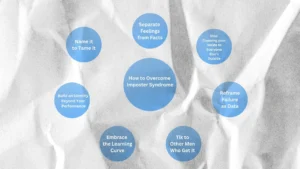
How to Overcome Imposter Syndrome: Steps That Actually Work
Let us get into the practical side — because you deserve more than a motivational poster telling you to “believe in yourself.”
1. Name It to Tame It
The first step in how to overcome imposter syndrome is deceptively simple: call it what it is.
When that familiar wave of self-doubt arrives — before a presentation, after a mistake, during a new role — say it out loud, or write it down: “This is imposter syndrome talking. This is not the truth.”
Neuroscience supports this. Research from UCLA shows that labelling emotions reduces activity in the amygdala (the brain’s fear centre) and activates the prefrontal cortex — the rational, reasoning part of your brain. In plain terms: naming your feelings actually calms them down.
You are not suppressing the doubt. You are refusing to let it drive.
2. Separate Feelings from Facts
Imposter syndrome thrives in the gap between feeling and reality. It takes a feeling — I do not know enough — and presents it as a fact.
Start building an “evidence file” — a running document, notebook, or even a notes app where you record:
- Compliments and feedback you have received
- Problems you solved that others could not
- Promotions, awards, or recognition you earned
- Moments you felt genuinely capable
When the inner critic fires up, open the file. Read it. That is the real data. Everything else is noise.
3. Stop Comparing Your Inside to Everyone Else’s Outside
Social media has turned comparison into a full-time sport — and it is rigged. You are measuring your internal experience (anxiety, doubt, confusion) against other people’s curated external presentation (confidence, success, achievement).
Nobody posts their panic attacks before a pitch. Nobody shares the morning they nearly called in sick because they could not face their inbox. But those moments exist for almost everyone.
According to a 2025 YouGov survey commissioned by the Mental Health Foundation UK, 71% of UK professionals admitted to regularly feeling that their peers were more confident and capable than they actually were. The perception and the reality are worlds apart.
You are not behind. You are just honest about being human.
4. Reframe Failure as Data
High achievers often develop imposter syndrome because they hold themselves to impossibly high standards. One mistake becomes proof of incompetence. One gap in knowledge becomes evidence that they do not belong.
But here is the truth: failure is information, not a verdict.
Every professional who has built something meaningful has a catalogue of missteps, wrong calls, and embarrassing moments. The difference between those who grow and those who shrink is not the absence of failure — it is whether they treat it as feedback or as a defining identity.
When anything goes wrong, ask yourself, “What does this teach me?”“ not “What does this say about me?”
5. Talk to Other Men Who Get It
This one is transformational — and the most underused.
There is something that happens when a man sits across from another man who has felt the same thing and chose to say so. The shame dissolves. The isolation breaks. The inner narrative shifts from “I’m the only one struggling” to “We’re all figuring this out.”
Men who engage in peer support communities report significantly better outcomes across mental health indicators. A 2024 NHS-commissioned report on men’s mental health in the West Midlands found that men who participated in structured peer support groups experienced a 42% reduction in anxiety symptoms and a 38% increase in self-reported confidence within just three months.
That is not a small effect. That is life-changing.
And yet, so few men take the step. Because asking for that kind of connection — openly, vulnerably — feels like the very thing imposter syndrome says you should not need.
Break that cycle. Deliberately.
6. Embrace the Learning Curve — It Is Not Fraud, It Is Growth
Here is a reframe worth sitting with: feeling like you do not know everything is not evidence that you do not belong. It is evidence that you are growing.
Genuine competence always feels incomplete from the inside. The moment you stop feeling out of your depth is the moment you have stopped pushing yourself. Discomfort at the edge of your capability is not a warning sign — it is a compass pointing in exactly the right direction.
The people who feel most confident are often those who have stopped learning. The people who feel most uncertain are often those who have not.
7. Build an Identity Beyond Your Performance
Imposter syndrome feeds on a fragile self-concept — one built almost entirely on professional performance. When your whole identity is tied to your job title, your output, or your image, any wobble at work becomes an existential threat.
Invest deliberately in who you are outside of what you achieve. Your relationships. Your physical health. Your passions. Your community. Your values.
When your sense of self is broader and more stable, the inner critic loses much of its power. You are not just “the manager,” or “the entrepreneur” or “the provider.” You are a full human being — with depth, history, and worth that no job title can define or diminish.
The Courage It Takes to Show Up Anyway
Here is what nobody tells you about imposter syndrome: overcoming it is not about eliminating the doubt. It is about acting despite it.
The most powerful men in any room are not the ones who feel no fear. They are the ones who feel it — and show up anyway. Who doubt themselves — and reach out anyway. Who feel like frauds — and keep going anyway.
That is not recklessness. That is real courage.
And real courage is built in community. In honesty. In the willingness to be seen — fully, not just the polished version — and to discover that you are still valued, still enough, still welcome.

You Do Not Have to Carry This Alone
If any part of this article has landed somewhere deep, here is what we want you to know:
There is a space for you.
🤝 Join Men’s Prosperity Club — Birmingham’s Free Mental Health Support Group for Men
Men’s Prosperity Club is more than a support group. It is a movement.
We have created a free mental health space dedicated to men who want peer support, personal growth, and genuine community connection. Whether you are battling imposter syndrome, navigating career stress, processing difficult emotions, or simply tired of carrying everything alone, this is a place where you are welcome exactly as you are.
What makes us different:
- Walk-and-talk sessions — conversations in motion, because sitting face-to-face is not always the easiest way to open up
- Horizontal leadership — no hierarchy, no judgment, no “expert at the front.” Just men holding space for each other
- A culture of vulnerability as strength — because it takes more courage to be honest than to pretend you have it all together
We do not just talk about being better men. We live it — together.
This is free. This is safe. This is yours.
Overcoming imposter syndrome does not start with a strategy. It starts with a conversation. And that conversation starts here.