

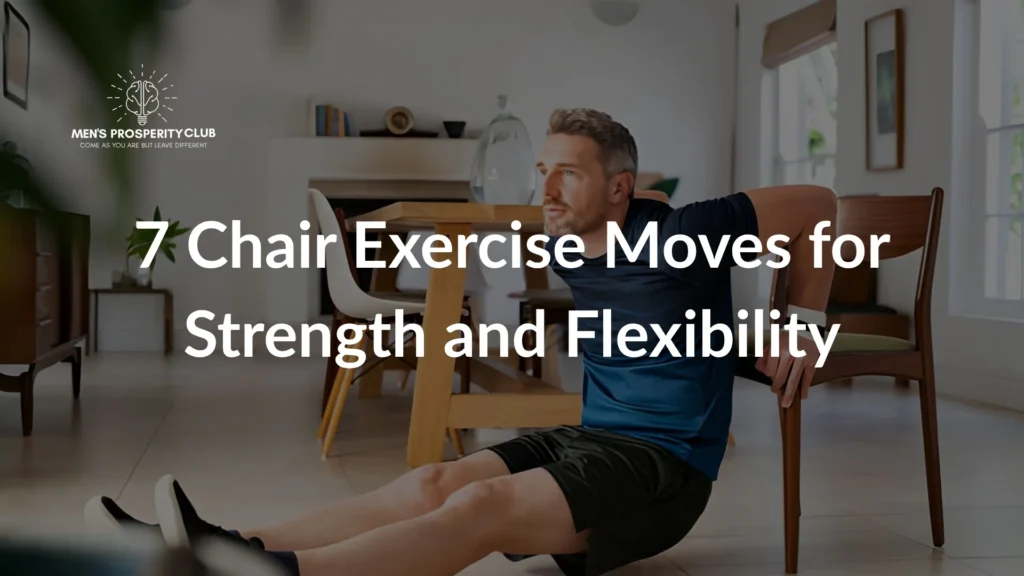
Let’s be honest — when most men hear the phrase “chair exercise”, the mind tends to wander somewhere unhelpful. Maybe you picture a waiting room, a rehab clinic, or a gentle seated stretch in a care home. If that’s where your imagination went, you’re far from alone. But here’s the truth: chair exercise is one of the most underrated, underused, and surprisingly effective tools available to men of all ages who want to move better, feel stronger, and take their wellbeing seriously.
Whether you spend long hours at a desk, you’re returning to movement after an injury, you want a low-impact option that doesn’t wreck your joints, or you simply need somewhere to start, chair exercise meets you exactly where you are. It asks for nothing fancy. No gym membership. No specialist equipment. Just a sturdy chair, a bit of space, and the willingness to show up for yourself.
In this article, we’re going to walk you through seven practical chair exercise moves that build genuine strength and flexibility. Along the way, we’ll explore why this style of movement matters so much for men’s physical health, mental wellbeing, and even social connection. And we’ll introduce you to a community in Birmingham that understands what it really means to support men in becoming their best selves.
Why Chair Exercise Deserves Far More Respect
There’s a stubborn cultural myth that exercise only counts if it’s intense, sweaty, and preferably involves heavy iron. For men especially, the pressure to push hard and go big can be both relentless and quietly damaging. But movement science tells a very different story.
According to Sport England’s Active Lives Adult Survey (2024–25), around 27% of adults in England remain physically inactive — meaning they do fewer than 30 minutes of moderate activity per week. Among men aged 35 to 54, that figure is stubbornly persistent, driven in large part by time pressures, physical barriers, and a belief that “proper” exercise is all or nothing. Chair exercise disrupts that thinking entirely.
The NHS consistently emphasises that any movement — regardless of intensity — is better than none. Chair-based exercise has been shown to improve cardiovascular function, build muscular endurance, increase joint mobility, and support better posture. It’s also deeply adaptable, meaning whether you’re 28 or 68, a seasoned athlete easing off load, or someone who’s barely moved in months, chair exercise can work for you.
The Mind-Body Connection: More Than Just Muscle
Before we get into the moves themselves, it’s worth pausing on something important: the impact of regular movement on mental health. In 2025, men’s mental health remains a national concern in the UK. The Campaign Against Living Miserably (CALM) reported that 75% of all suicide deaths in the UK are male — a statistic that demands our attention, not our silence.
Research consistently shows that physical movement — even in gentle, accessible forms like chair exercise — can reduce anxiety, ease low mood and boost cognitive function. When you engage your body, you inevitably engage your mind. The two are not separate systems. A man who takes care of how he moves is also, quietly, taking care of how he thinks and feels.
That’s why the work being done by groups like Men’s Prosperity Club in Birmingham matters so profoundly. Men’s Prosperity Club offers a free space for men seeking peer support, personal growth, and community connection. More than just a group, it’s a movement that encourages men to express themselves openly and authentically. Through unique walk and talk sessions and a horizontal leadership model, they create a safe space where vulnerability is embraced as strength.
The connection between physical movement and emotional openness is real. When men start moving their bodies with intention — whether through a chair exercise routine at home or walking alongside others in a supportive group — something shifts. There’s a kind of permission that comes with it. Permission to take up space. Permission to matter.
7 Chair Exercise Moves to Build Strength and Flexibility
These seven moves form a complete chair exercise routine that targets the major muscle groups, improves flexibility, supports posture and gets the blood moving. Aim to complete them three to four times per week for noticeable results. Use a firm, stable chair with no wheels, and always warm up with two to three minutes of seated breathing and shoulder rolls before you begin.
1. Seated Leg Extensions — Quad Strength and Knee Health
Sit tall with your back off the chairback, feet flat on the floor. Slowly extend your right leg until it’s straight, hold for two seconds, then lower it without letting your foot touch the floor. Complete 12 reps, then switch legs.
This move strengthens the quadriceps, supports knee joint health, and helps combat the quad weakness that often develops in men who sit for long stretches. It’s a quiet powerhouse of a chair exercise — simple on the surface, genuinely effective underneath.
2. Seated Chest Press with Resistance Band — Upper Body Strength
Loop a resistance band around the back of your chair at chest height. Sit tall, hold one end in each hand, and press both arms forward until they’re fully extended. Slowly return. Aim for three sets of 10 to 12 reps.
This chair exercise directly challenges the pectoral muscles, anterior deltoids, and triceps. If you don’t have a resistance band yet, pressing palms against each other in an isometric press works well as an alternative while you build up your kit.
3. Chair Sit-to-Stand — Functional Strength for Real Life
Sit at the edge of your chair with feet hip-width apart. Cross your arms over your chest, lean slightly forward from the hips, and drive through your heels to stand. Lower yourself slowly back down — resisting gravity the whole way. That’s one rep. Do 10 to 15.
This is arguably the most important chair exercise in the list. The sit-to-stand movement directly mirrors what your body does dozens of times daily — and how well you perform it reflects your overall lower body strength, balance and coordination. Studies published in the European Journal of Preventive Cardiology have linked the ability to perform this movement with long-term health outcomes in men.
4. Seated Spinal Rotation — Core and Flexibility
Sit tall, feet flat, hands lightly crossed over your chest or resting on your shoulders. Breathe in. As you exhale, rotate your torso slowly to the right, hold for three seconds, and return to centre. Repeat to the left. Do eight repetitions on each side.
For men who carry tension in their lower back — which, according to the British Pain Society, affects around a third of the UK adult population — this chair exercise is genuinely therapeutic. It mobilises the thoracic spine, releases built-up tension, and gently engages the obliques. Do it slowly and with full breath to get the most from it.

5. Chair Tricep Dips — Upper Arm and Shoulder Stability
Sit at the edge of your chair and grip the seat beside your hips. Slide your body forward off the seat, keeping your knees bent at 90 degrees. Lower yourself towards the floor by bending your elbows, then press back up. Aim for three sets of eight to ten reps.
This is a surprisingly demanding chair exercise that builds real strength in the triceps and stabilises the shoulder girdle. If this feels too intense initially, reduce the depth of your dip until strength develops. Progress, not perfection, is the goal.
6. Seated Hip Flexor Stretch — Combating the Desk Posture
Sit sideways on your chair, so your left hip is at the edge. Let your right leg slide back until you feel a stretch at the front of the hip. Keep your torso upright, engage your core gently, and hold for 30 to 45 seconds. Switch sides and repeat.
Tight hip flexors are one of the most common postural issues affecting men who work at desks or drive for long periods. This chair exercise stretch counters that tightness directly. It also tends to come with an almost immediate sense of physical relief, which makes it one of the most enjoyable moves in the sequence.
7. Seated Core Hold with Arm Raises — Stability and Endurance
Sit tall with feet lifted slightly off the floor, knees bent. Hold this position while you slowly raise your right arm to shoulder height, lower it, then raise your left. That’s one rep. Continue for 10 to 12 repetitions while keeping your core engaged throughout.
This final chair exercise challenges your core stability, balance, and shoulder endurance simultaneously. It’s deceptively hard, especially if you try to keep your seated posture tall and controlled throughout. Finish strong with this one, and you’ll feel the difference within a week or two of consistent practice.
Consistency Over Intensity: The Real Secret
One of the biggest mistakes men make when starting any exercise programme — including chair exercise — is going hard for a week and then disappearing entirely. The body doesn’t respond to heroics; it responds to habit. A 20-minute chair exercise session, done consistently three times a week, will deliver far greater long-term results than an intense hour-long session followed by three weeks of inactivity.
This isn’t just anecdotal. Public Health England’s physical activity guidelines stress that regularity and sustainability are the cornerstones of genuine health improvement. When you find a form of movement you can actually stick to — one that fits your life, your schedule, your body — you’ve found something genuinely powerful. Chair exercise, for many men, is exactly that.
Training the Mind Alongside the Body
There’s a particular kind of courage required of men who decide to take their wellbeing seriously. It goes against a cultural grain that still too often tells men to be silent, to push through, to not make a fuss. But that grain has a cost — and in the UK in 2025, that cost is measurable in lives lost.
Starting a chair exercise routine is, in its own quiet way, an act of self-respect. It says: I’m worth looking after. But physical movement alone isn’t always enough. Sometimes the heaviness a man carries isn’t in his muscles — it’s somewhere deeper. That’s where community becomes essential.
Men’s Prosperity Club Birmingham Mental Health Support Group was built precisely for this. Their approach recognises that men grow best not in isolation but in the company of other men who are also doing the honest, unglamorous work of becoming healthier and more whole. Their walk and talk sessions bring the benefits of movement and conversation together in a way that feels natural rather than clinical — because for many men, talking becomes easier when you’re moving.
If you’ve been meaning to address both your physical and mental health but haven’t quite found the right door in, consider this your nudge. A chair exercise routine to start the body moving. A community like Men’s Prosperity Club to start the mind opening.

Making Chair Exercise Work for Your Lifestyle
Here are a few practical tips to help you embed this routine into your week:
- Attach it to something you already do. Morning coffee. Lunchbreak. Before the evening news. Habit stacking makes new behaviours stick far more reliably.
- Start with just three moves. You don’t have to do all seven from day one. Pick three that feel accessible and build from there.
- Track how you feel, not just what you did. The mental shift — the calm after, the sense of having done something for yourself — is data worth noting.
- Invest in a resistance band. A basic set costs under £10 and dramatically expands what you can do with chair exercise.
- Tell someone you’re doing it. Accountability doesn’t have to be formal. Even mentioning it to a friend creates a small but meaningful commitment.
“Men’s Prosperity Club offers a free men’s mental health support space dedicated to men seeking peer support, personal growth and community connection. More than just a group, it’s a movement that encourages men to express themselves openly and authentically. Through unique walk and talk sessions and a horizontal leadership model, we create a safe space where vulnerability is embraced as strength.”
— Men’s Prosperity Club Birmingham
Movement Is the Message
Chair exercise is not a compromise. It’s not a lesser version of “real” training. It’s a practical, powerful, and profoundly accessible form of movement that meets men exactly where they are — and helps them get to somewhere better.
The seven moves in this article will build your strength, increase your flexibility, support your posture, and — done consistently — contribute meaningfully to your long-term health. But the real invitation here is bigger than bicep strength or hip mobility. It’s about deciding that you’re worth the effort. That your body deserves attention. That your mind deserves support.
For men in Birmingham and beyond, Men’s Prosperity Club stands as proof that that kind of support is possible — free, genuine, and built around what men actually need: movement, honesty, and community.
So pull up a chair. Not because you can’t do anything else — but because you’ve decided to start. And starting, as any man who has done the work will tell you, is everything.